
Tuesday, October 4, 2011


Tuesday, August 23, 2011
Arrived in the UK
Thinking this blog is ready to be closed down...
I'm ready to deploy internet time resources on new site for St Bees Priory on cloversites.
I'm ready to deploy internet time resources on new site for St Bees Priory on cloversites.
Thursday, May 5, 2011
Prayer is Free
My friend Amy Julia Becker keeps a wonderful web journal reflecting on life and particularly on what she learns through parenting, and then especially through parenting one of her three children who has Down's Syndrome. This delightful girl, Penny, opens up a world of unexpected spiritual treasures to Amy Julia's readers. I commend the blog to you. This week, Amy Julia noted that a book sold at Christ Church's booktable is being given away free to those of you who use the kindle electronic book reader. You can get your copy here.
The book is on prayer, and has made a positive impact on a number of parishioners at Christ Church. The free book on prayer reminds me that prayer is always free -- both in the sense that we do not pay for it and that God freely accepts our prayer because Jesus invites us into His presence.
In the church calendar, we are still a ways from Ascension, yet the topic of prayer brings to mind how thankful we can be that our prayers don't bounce off the ceiling, but can be heard by God:
The book is on prayer, and has made a positive impact on a number of parishioners at Christ Church. The free book on prayer reminds me that prayer is always free -- both in the sense that we do not pay for it and that God freely accepts our prayer because Jesus invites us into His presence.
In the church calendar, we are still a ways from Ascension, yet the topic of prayer brings to mind how thankful we can be that our prayers don't bounce off the ceiling, but can be heard by God:
14 Therefore, since we have a great high priest who has ascended into heaven, Jesus the Son of God, let us hold firmly to the faith we profess. 15 For we do not have a high priest who is unable to empathize with our weaknesses, but we have one who has been tempted in every way, just as we are—yet he did not sin. 16 Let us then approach God’s throne of grace with confidence, so that we may receive mercy and find grace to help us in our time of need.
(Hebrews 4.14-16)
Friday, March 18, 2011
et in Arcadia ego
The Authoress shared her joy for the play Arcadia with me earlier this month, when we saw a revival production on Broadway.
The play is set in Sidley Park, an English manor house. The action moves between 1809 and present day, with the characters in one time revealing things about those in the other time through dialogue that is full of wit, literature, mathematics and depth of observation.
The Independent newspaper review of the play holds that it is one of the most important of the 20th century, probing issues of the meaning of life. The summary of the issues is as follows:
Yet it isn't really a pure quest for knowledge. Rather this noble pursuit is mingled with the desire for self-glory. One aspect that the reviewer, and many articles about Arcadia seem to miss out, is that the main characters in the present day are academics whose passion for their subject, for solving puzzles, for discovering links in history about Lord Byron, or the history of landscape gardening or literature, of mathematical proofs -- is that this pursuit of knowledge, even the pursuit of love, is mixed in the with the pursuit of self-glory. The characters have a refrain that drives them -- to publish their findings, and be lauded by their peers. Perhaps to the journalist or to Stoppard himself as those who publish work, this is not as self-evident as it was to me (whose seeking plaudits no doubt takes different form than the published word).
I had another reaction to the play -- it made me think about the presupposition we have about the world as we approach it -- is it fundamentally good or evil? Christianity sees it as good but fallen, beautiful yet corrupted.
This came to mind not only as I interacted with a biblical text in the past couple of weeks (on salt and light), but also in the Christian stance of hope, against the notion that life ends "at room temperature". An Anglican minister (writing about an entirely different subject, namely, church politics) made an observation that is apropos of the central issue in Arcadia. It is, in a sense, the Christian response to the despair or at least struggle in the musings of several of Tom Stoppard's characters. Charles Raven wrote:
The paintings from which Stoppard's play draws its title (and theme) are two by Poussin (the later work is shown here) and one by Guercino: Et in Arcadia ego. This is the inscription on the tombstone happened upon by three shepherds and a shepherdess. There are some interesting articles on the meaning of the paintings and indeed the inscription itself, but however construed, there is the fact of death existing even in the midst of the beauty of Arcadia. This is true in the play, as tragedy frames the relationships, and even there in the midst of the beauty (whether ordered or disordered) of the English country house, death lurks. And so the Resurrection and the promise of life speaks a word of rebuke to death.
Gentle reader, your thoughts on Arcadia are welcome; and if you come to NYC to see it, I'll send you a discount code, perhaps we can meet up for coffee...
 | ||
| Photo: Catherine Ashmore, New York Times |
The play is set in Sidley Park, an English manor house. The action moves between 1809 and present day, with the characters in one time revealing things about those in the other time through dialogue that is full of wit, literature, mathematics and depth of observation.
The Independent newspaper review of the play holds that it is one of the most important of the 20th century, probing issues of the meaning of life. The summary of the issues is as follows:
The classical order – which mutated into the Enlightenment – believed the world was ordered and was governed by rules that could be slowly uncovered. The Romantics believed this was a suffocating cage in which humanity was being imprisoned, and sought to overthrow all rules in the name of individual creativity. You make up your own rules as you go along: every man is an artist. There is no order other than the one you invent.
Septimus Hodge is a brilliant tutor [and classmate of poet Lord Byron] who teaches his student [a thirteen year old girl named Thomasina who is a math prodigy] about Newton's laws of physics. They are clean, clear, promising an underlying, predictable order to the universe. Thomasina...spots a series of dark flaws in Newton.
She explains that...there is one equation that runs only one way: heat turns to cold. The same thing is happening everywhere, all the time: it's called the Second Law of Thermodynamics. The implications – only just being grasped by the generations after Newton – were plain, and bleak. "It'll take a while, but we're all going to end up at room temperature," says one character. Septimus – sobered by Thomasina's explanation – adds softly: "So the Improved Newtonian Universe must cease and grow cold."
These are characters who take the implications of their ideas seriously. Septimus and Thomasina are stricken by the realisation that instead of setting up a perfectly ticking and well-oiled machine, Newtonian physics exposed us as living in an irrevocably doomed world.The characters in the play Arcadia react to the world in different ways -- that there is inevitable decline and destruction seems unbelievable when there on the stage are young and vibrant characters -- two main reactions. One is to turn aside from science, and seek meaning and solace in romantic poetic ideals (what Dylan Thomas would later exhort, to rage against the dying of the light). The other is to see the desire to learn as the mark of a significant life. The Independent review continues:
In the most important speech in the play, Hannah suggests the answer lies in the process of trying to understand, while you can. You find meaning by questing on, even in the face of failure and extinction. She tells Valentine: "It's all trivial...Comparing what we're looking for misses the point. It's wanting to know that makes us matter...Better to struggle on knowing that failure is final."
http://www.independent.co.uk/arts-entertainment/theatre-dance/features/is-tom-stoppards-arcadia-the-greatest-play-of-our-age-1688852.html Independent 22 May 2009
Yet it isn't really a pure quest for knowledge. Rather this noble pursuit is mingled with the desire for self-glory. One aspect that the reviewer, and many articles about Arcadia seem to miss out, is that the main characters in the present day are academics whose passion for their subject, for solving puzzles, for discovering links in history about Lord Byron, or the history of landscape gardening or literature, of mathematical proofs -- is that this pursuit of knowledge, even the pursuit of love, is mixed in the with the pursuit of self-glory. The characters have a refrain that drives them -- to publish their findings, and be lauded by their peers. Perhaps to the journalist or to Stoppard himself as those who publish work, this is not as self-evident as it was to me (whose seeking plaudits no doubt takes different form than the published word).
I had another reaction to the play -- it made me think about the presupposition we have about the world as we approach it -- is it fundamentally good or evil? Christianity sees it as good but fallen, beautiful yet corrupted.
This came to mind not only as I interacted with a biblical text in the past couple of weeks (on salt and light), but also in the Christian stance of hope, against the notion that life ends "at room temperature". An Anglican minister (writing about an entirely different subject, namely, church politics) made an observation that is apropos of the central issue in Arcadia. It is, in a sense, the Christian response to the despair or at least struggle in the musings of several of Tom Stoppard's characters. Charles Raven wrote:
One way to express the power of the resurrection is to say that it gloriously breaches the second law of thermodynamics. Our hope of a new heaven and a new earth is grounded in Christ's physical resurrection as a reversal of entropy - and that power of the resurrection is at work in the Church now, not through resourceful words or the control of money, but through faithfulness to God's Word and the renewing power of the Holy Spirit.
http://www.anglicanspread.org/?p=432
 |
| Et In Arcadia Ego, Nicholas Poussin (Louvre, Paris), artinthepicture.com |
Gentle reader, your thoughts on Arcadia are welcome; and if you come to NYC to see it, I'll send you a discount code, perhaps we can meet up for coffee...
Thursday, February 17, 2011
Man Bag
Gentle reader, apologies for the dearth of entries of late.
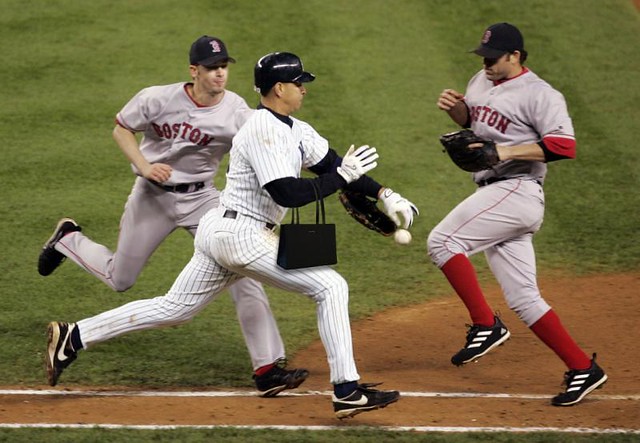
The photo below will appeal to fans of the Boston Red Sox, who will snicker at Alex Rodriguez being called out for knocking the ball from the opposing player's glove (a foul in baseball).
 An article in the Daily Telegraph struck home lately. It was on the subject of back pain that men have caused by carrying a "man bag". I have experienced this, when carrying my laptop, various commentaries/books/etc around in my leather attache. I call it a "messenger bag" and this is how it is advertised, rather than "man purse"! It looks like the bag I saw in the Wells Fargo museum, from the old Pony Express days.
In the Telegraph article, two photos are provided, one of Jude Law carrying what seems to be a purse, the other of David Beckham carrying a suitcase and, slung over his shoulder, what looks to me like what I term a "messenger bag". But the article wishes to associate this with the purse in the first photo. I don't take David Beckham's fashion sense as the height of either style or masculinity, but surely there is a differentiation between the two? The point of the article is to say that guys are hurting their shoulders carrying around lots of stuff. True for me as I have the thing slung over my shoulder for a couple of hours a day sometimes.
The Swiss Army once used the bags pictured below for messengers carrying maps. And the next picture is of a bag for carrying ammunition.
What think the fashionistas among you? Is there any alternative to the square briefcase or the hiker's backpack? Is Jerry Seinfeld right, "It's not a purse, it's European!"?


Or perhaps I've been in a metropolitan setting too long, and need to get a grip.
The photo below will appeal to fans of the Boston Red Sox, who will snicker at Alex Rodriguez being called out for knocking the ball from the opposing player's glove (a foul in baseball).
In the Telegraph article, two photos are provided, one of Jude Law carrying what seems to be a purse, the other of David Beckham carrying a suitcase and, slung over his shoulder, what looks to me like what I term a "messenger bag". But the article wishes to associate this with the purse in the first photo. I don't take David Beckham's fashion sense as the height of either style or masculinity, but surely there is a differentiation between the two? The point of the article is to say that guys are hurting their shoulders carrying around lots of stuff. True for me as I have the thing slung over my shoulder for a couple of hours a day sometimes.
The Swiss Army once used the bags pictured below for messengers carrying maps. And the next picture is of a bag for carrying ammunition.
What think the fashionistas among you? Is there any alternative to the square briefcase or the hiker's backpack? Is Jerry Seinfeld right, "It's not a purse, it's European!"?
Or perhaps I've been in a metropolitan setting too long, and need to get a grip.
Monday, December 20, 2010
Genealogy of Jesus: the Golden Thread of Salvation
Yesterday at Christ Church we had the genealogy of Jesus from Matthew chapter one. It is the sort of passage that I love to preach on -- at first glance, it seems just that sort of dry and dusty bit that makes the Bible seem boring. So it is great to have the conviction that the whole of the scriptures are the Word of God, because it gives an encouragement to stay with a passage and dig into it. And so often there are surprising treasures!
The genealogy of Jesus tells us many things, not least that God is patient and faithful in bringing his promises to fruition. This gives us confidence in other things he promises, that we can trust them to be brought to fruition, too. As Jesus is described as the king in David's line, we are encouraged to look to him as the leader of our own life. Finally, the experience of exile is historical for God's people, but also experienced as our ultimate home (ie, heaven) is not this world. The "shady ladies" (Gentiles, with various sexual histories) and the variety of examples of men (David, who killed his old comrade Uriah to cover up an affair; Abraham, with his wonderful faith but also his betrayal of his wife's safety to save his own skin; many others) show that no one is beyond the reach of God's loving grace, and indeed can be used to bring about his purposes. It is also encouraging to see a bum like Manasseh come to repentance late in life and have a strong grandson like Josiah, though a warning that a great man like Josiah's own grandson would be a bum (Jechoniah). We need to pray for our kids and our community earnestly!
I hope next year to teach the children this wonderful song during Advent, with kudos to singer/songwriter/author Andrew Peterson for his making the passage vibrant for children in song and animation:
With thanks to "The Vicar's Wife", a blog that the Authoress views and sends my way on occasion.
1 The book of the genealogy of Jesus Christ, the son of David, the son of Abraham.
2 Abraham was the father of Isaac, and Isaac the father of Jacob, and Jacob the father of Judah and his brothers, 3and Judah the father of Perez and Zerah by Tamar, and Perez the father of Hezron, and Hezron the father of Ram, 4and Ram the father of Amminadab, and Amminadab the father of Nahshon, and Nahshon the father of Salmon, 5and Salmon the father of Boaz by Rahab, and Boaz the father of Obed by Ruth, and Obed the father of Jesse, 6and Jesse the father of David the king.
And David was the father of Solomon by the wife of Uriah, 7and Solomon the father of Rehoboam, and Rehoboam the father of Abijah, and Abijah the father of Asaph, 8and Asaph the father of Jehoshaphat, and Jehoshaphat the father of Joram, and Joram the father of Uzziah, 9and Uzziah the father of Jotham, and Jotham the father of Ahaz, and Ahaz the father of Hezekiah, 10and Hezekiah the father of Manasseh, and Manasseh the father of Amos, and Amos the father of Josiah, 11and Josiah the father of Jechoniah and his brothers, at the time of the deportation to Babylon.
12And after the deportation to Babylon: Jechoniah was the father of Shealtiel, and Shealtiel the father of Zerubbabel, 13and Zerubbabel the father of Abiud, and Abiud the father of Eliakim, and Eliakim the father of Azor, 14and Azor the father of Zadok, and Zadok the father of Achim, and Achim the father of Eliud, 15and Eliud the father of Eleazar, and Eleazar the father of Matthan, and Matthan the father of Jacob, 16and Jacob the father of Joseph the husband of Mary, of whom Jesus was born, who is called Christ.
17So all the generations from Abraham to David were fourteen generations, and from David to the deportation to Babylon fourteen generations, and from the deportation to Babylon to the Christ fourteen generations.
The genealogy of Jesus tells us many things, not least that God is patient and faithful in bringing his promises to fruition. This gives us confidence in other things he promises, that we can trust them to be brought to fruition, too. As Jesus is described as the king in David's line, we are encouraged to look to him as the leader of our own life. Finally, the experience of exile is historical for God's people, but also experienced as our ultimate home (ie, heaven) is not this world. The "shady ladies" (Gentiles, with various sexual histories) and the variety of examples of men (David, who killed his old comrade Uriah to cover up an affair; Abraham, with his wonderful faith but also his betrayal of his wife's safety to save his own skin; many others) show that no one is beyond the reach of God's loving grace, and indeed can be used to bring about his purposes. It is also encouraging to see a bum like Manasseh come to repentance late in life and have a strong grandson like Josiah, though a warning that a great man like Josiah's own grandson would be a bum (Jechoniah). We need to pray for our kids and our community earnestly!
I hope next year to teach the children this wonderful song during Advent, with kudos to singer/songwriter/author Andrew Peterson for his making the passage vibrant for children in song and animation:
With thanks to "The Vicar's Wife", a blog that the Authoress views and sends my way on occasion.
Friday, November 26, 2010
Thankgiving Decree
The New York Times noted the tradition of Thanksgiving Proclamations by politicians in American history. These are still made today. I have been moved by the Presidential decrees proclaiming national days of Thanksgiving in the past (particularly by Lincoln and one of Franklin Roosevelt's decrees).
I hadn't really been aware that state governors also issued such proclamations, and found myself moved by the lofty one issued by the Governor of Connecticut in the midst of the Great Depression. He was a retired Yale professor, incidentally, which makes me glad such men enter public service:
Time out of mind at this turn of the seasons when the hardy oak leaves rustle in the wind and the frost gives a tang to the air and the dusk falls early and the friendly evenings lengthen under the heel of Orion, it has seemed good to our people to join together in praising the Creator and Preserver, who has brought us by a way that we did not know to the end of another year. In observance of this custom, I appoint Thursday, the twenty-sixth of November, as a day of Public Thanksgiving for the blessings that have been our common lot and have placed our beloved State with the favored regions of earth -- for all the creature comforts: the yield of the soil that has fed us and the richer yield from labor of every kind that has sustained our lives -- and for all those things, as dear as breath to the body, that quicken man's faith in his manhood, that nourish and strengthen his spirit to do the great work still before him: for the brotherly word and act; for honor held above price; for steadfast courage and zeal in the long, long search after truth; for liberty and for justice freely granted by each to his fellow and so as freely enjoyed; and for the crowning glory and mercy of peace upon our land; -- that we may humbly take heart of these blessings as we gather once again with solemn and festive rites to keep our Harvest Home.
A bit more significant than flirting with gluttony and a having an intense focus on sales in the shops, eh? I found Wilbur Cross's statement most encouraging.
When I pray with the children at night, we pray the Lord's Prayer, then for concerns of the day. And we try to have most of it giving thanks, always including a standard statement, "Thank you, Jesus, for loving [Number One Son, etc]". That is the great reason to be thankful, that our Creator not only made the world, nor even that as Preserver he continues to sustain life, but that we can relate to him personally through his Son. Astonishing. Puts even the poetic notions of the beauty of the stars into perspective.
A recent photo from the Hubble Space Telescope encourages reflection on Psalm 8:3-4

3When I look at your heavens, the work of your fingers,
the moon and the stars, which you have set in place,
4 what is man that you are mindful of him?
So, yesterday's turkey, mince pie (and pumpkin...), autumn squash vegetable dishes and so forth -- all evidence of God's care. And a pointer, to the greater provision by God, which brings us to Advent Season this Sunday...
Sources: http://www.jud.ct.gov/lawlib/history/thanksgiving.htm
http://hubblesite.org/gallery/album/pr2005002f/
Thursday, November 18, 2010
Epiphany a bit early?
New York City never ceases to amaze. Outside the building where our church administrative office is located, I came upon these three camels. Illegally parked.


Friday, November 12, 2010
The First Existentialist

In fact, it seems to be the case that Ecclesiastes largely anticipates a number of later philosophical works, including Kierkegaard and other existentialists. The book also engages with Aristotle on the point of whether acquiring wisdom is the most fulfilling endeavour for a person.
I don't know if you have twenty-five minutes to fill in a commute or run, gentle reader; but if so, here is my sermon on Ecclesiastes chapters 1 & 2, which you can read here.
The sermon is linked to this post. It starts off with my accidentally shouting into the microphone, until the sound man rescued me...
photo: Woody Allen www.listal.com
Wednesday, November 3, 2010
Kipper & A Club

I live in New York City, and things are always happening. People come here from great distances and at massive expense to attend meetings that I skip because there are ten more such opportunities in a single week. The options in New York City can become something of a crushing overload, even as the possibility of going to, say, a director's cut of Once Upon a Time in America (a film four hours long) or seeing the artifacts of Robert Scott's doomed mission to the South Pole, thrills me. (I have done both these things, the former as a single man long ago, the latter with my kids, twice.)
It can be hard to think and process life in the midst of the pace of city life. I do see people tune out with their iPod headphones, but it's just not for me. It is a glorious thing to be able to pray while hurtling downtown on a subway line or walking along an avenue, but it's still doing something (in this case, something extremely valuable).
Many New Yorkers need to get out of the city occasionally in order to enjoy it. As it happens, circumstances have kept me in the city almost straight since the end of August. So two things today struck me as a relief from the pace.

The first: Kipper.
Kipper the Dog is an animated character of Mike Inkpen, who also has illustrated/written some Bible stories we have for the children. The beauty of Kipper episodes is that nothing really happens. He meets up with his friends, Tiger (the terrier) and Pig (the pig) and they chat, play and get up to various adventures of minimal scope. Postman Pat is also a bit like this. Very little action, but a lot of involvement with the characters and their pleasant meanderings. Kipper is currently Top of the Pops for our two year old, but we all sneak a peak whenever it's on.

The second: A Club
I lead Bible studies for people who work in finance and other professional jobs. These occur during the course of the work day, which brings a whole different slant on the issues. I had this experience myself when working for a bank -- how different cracking open the Bible was at work rather than after work or on the weekends. Anyway, some of the meetings happen in a posh club off Wall Street. I typically meet up with guys to chat and pray afterwards, and today had a few minutes in between conversations. And so I sat in a wood-panelled room with an enormous stuffed and mounted elk's head on the walls, and sank into a leather chair. And read through Country Life magazine, which is essentially a giant advertisement section for lovely country houses and antiques in Britain, mixed in with a few articles.
Silence, except the turning of my pages, and the creaking of the leather chair. Bliss.
I know that the heavenly city is, well, a city. But even so, we read in Revelation 8:1 that "there was silence in heaven about the space of half an hour." And I was glad for my five minutes.
What do you think, gentle reader -- Is full throttle in NYC sustainable for the soul? Positively good for it, or a mixture?
Tuesday, September 28, 2010
Phillips Brooks
Phillips Brooks is probably best known as the author of the Christmas carol "O Little Town of Bethlehem". He was a clergyman who served in Philadelphia and Boston, as rector of Trinity Church. One fact that caught my attention when I first came across him (apart from the Christmas carol) was that he was much beloved of Harvard students as an honorary (more or less) chaplain to the university. On his death, he was carried in a sturdy coffin three miles from Cambridge to Boston, in part by the Varsity Eight rowing squad. This was impressive as Brooks was 6'3" and weighed 300 lbs! His sermon to newly arrived freshman on their college life and living in general is inspiring.

Below is a meditation on John 10:10, in which Jesus says:
The thief cometh not, but for to steal, and to kill, and to destroy: I am come that they might have life, and that they might have it more abundantly.
photo: www.philadelphia-reflections.com
Below is a meditation on John 10:10, in which Jesus says:
The thief cometh not, but for to steal, and to kill, and to destroy: I am come that they might have life, and that they might have it more abundantly.
"...the danger of men is not in too much life but in too little. It is deficient vitality, not excessive vitality, that makes the mischief and trouble of the world. Below the question of whether a being is living well or living ill there is the deeper question of whether he is living at all. The great hunger everywhere is for life. All unliving things are reaching up towards it. All living things are craving an increase of it. Into this world comes Christ and announces himself as that world's savior and satisfier..."
photo: www.philadelphia-reflections.com
Wednesday, September 22, 2010
Richard Wilbur, "Games Two"
The last few lines of this poem seem to capture the nature of Christian hope wonderfully.
:
Still, As pilgrims on a hill
Fallen, behold
With failing eyes from far
The desired city,
Silence will take pity
On words. There are
Pauses where words must wait,
Spaces in speech
Which stop and calm it, and each
Is like a gate:
Past which creation lies
In morning sun,
Where word with world is one
And nothing dies.
-Former Poet Laureate Richard Wilbur (born 1921), “Games Two”
Thursday, August 26, 2010
City on a Hill, Law & Love

In preparation for an upcoming series in the Christ Church "More to Life: Wall Street Ministry", I was reading some English and American Puritans. The seventeenth century spiritual giants have a lot to say to us!
John Winthrop was aboard the Arabella from England to America in 1640 when he wrote a sermon that used the phrase "a city on a hill" (from the Sermon on the Mount) to describe his hopes for the new land. This phrase was quoted by John Kennedy and Ronald Reagan in significant speeches to show their hopes for America.
Kennedy and Reagan both made inspiring speeches (they are both worth reading, especially Reagan's farewell speech in 1989), casting their vision for America that was full of integrity, courage and good judgment. Both, however, missed Winthrop's point.
Interestingly, Winthrop's use of that phrase "a city on a hill" was in his summation of his whole sermon, which was on the topic of Christian charity. He enjoined the colonists to love one another with brotherly affection, and to treat one another with mercy and justice. So, far from being a statement of (merely) American exceptionalism, it was a statement that summed up Christian aspiration for mutual love. It is a good example of the Puritans having a solid understanding of human nature (that love rather than external laws changes a person). Winthrop wrote:
Soe the way to drawe men to the workes of mercy, is not by force of Argument from the goodness or necessity of the worke; for though this cause may enforce, a rationall minde to some present act of mercy, as is frequent in experience, yet it cannot worke such a habit in a soule, as shall make it prompt upon all occasions to produce the same effect, but by frameing these affections of loue in the hearte which will as naturally bring forthe the other, as any cause doth produce the effect.
So, gentle reader, what think ye of Winthrop: a man can be led to do something once by argument, but a habit only grows from love?
The full text of Winthrop's sermon may be read here (link to the Winthrop Society).
Portrait of John Winthrop, Massachusetts State House Art Collection.
Thursday, July 29, 2010
Word Cloud
After about twenty months, these are the words/topics that have appeared most frequently on this weblog:


Monday, July 26, 2010
Mad Men, redux
 Mad Men Barbie doll collection, image from amctv.com
I sent out the following invitation to some guys for a "Beef, Bible & Beer" evening, which I share so that I can see if you feel the same way about Mad Men and contentment. Beyond what's below, it would seem that the fourth series of the show is at that moment when the everyday features of life (particularly clothes, but behaviors, too) were still hanging onto the 1950's, but were about to give way to what is popularly conceived of as the 1960's (which is really 1968 onwards).
Gents --
It's been observed by many that the television show Mad Men uses light and darkness on camera to show that life at the office is bright and exciting while life at home is dark and dreary. Many men experience this: work hard at the office and get rewarded for it at the office; work hard at the office so that home can function and be rewarding, but come home and everything is actually hard. Many a man who doesn't, or is made to feel that he doesn't, meet expectations among family or friends, drives himself more at work -- which rewards him for it and encourages him with a sense of success.
The root of this cycle is a lack of contentment in what we've been given (in terms of relationships, abilities or even amount of time). And a lack of contentment in our circumstances leads to, initially, a "chasing after wind" as termed in Ecclesiastes, with wealth and pleasure our goals. Like the first couple seasons of Mad Men. Lack of contentment leads eventually to self-destruction, or what the Apostle Paul termed "glorying in shame" in Philippians 3. Like the last season of Mad Men, and where this season seems to be going. Who is Don Draper? A man who needs grace, and who needs to learn the secret of contentment. Next Sunday, we'll be looking at Philippians 4 at Christ Church. This Thursday, we can chat through the passage together in greater depth.
Come along to Beef, Bible & Beer this Thursday...
What do you think? Are there any spiritual questions arising from Mad Men beyond these? It seems like the alienation and destruction is fairly universal among the main characters. Of course, it is their deep flaws that draw us in -- I just wonder if they'd be so interesting if it wasn't for the cool clothes!
I need to admit that I haven't watched too much of the show -- but the few episodes I've seen have pretty much shouted out: "This is life without God...this is life lived only for now!"
Saturday, June 26, 2010
Tube Map
I found this rendition of the London Underground map by artist Barbara Kruger fascinating, with thanks to my contemporary art historian sister who noted it to me:


As a parlor game, and out of interest, I put blank labels into the New York City subway map for guests at a recent party to fill out. Or rather, to "Manhattanize" the map with inspiration from Kruger. What sort of phrases/words do you think were included? People seemed to take care to attach certain phrases to places in New York.
As a parlor game, and out of interest, I put blank labels into the New York City subway map for guests at a recent party to fill out. Or rather, to "Manhattanize" the map with inspiration from Kruger. What sort of phrases/words do you think were included? People seemed to take care to attach certain phrases to places in New York.
Friday, June 25, 2010
Manute Bol

A stimulating article appeared in the Wall Street Journal about the late Manute Bol's charitable work in the Sudan, and his sacrificial giving to alleviate the suffering of his people. The writer contrasts the meaning of the word "redemption" with the term's usage among sports writers. I hadn't known of Bol's activities or his faith until reading in an article that the death was announced by a friend's husband, who leads a Christian reconciliation and development agency in the Sudan (which I encourage you to support).
The contrast of the word redemption is below and the full article can be read here:
What does redemption mean in the world of professional basketball and sports more broadly? It involves making up for—or, yes, "atoning"—for a poor performance. When the Lakers beat Boston, for instance, Bill Plaschke of the Los Angeles Times called the victory "redemption for the Celtics' 2008 Finals beating."
More often, though, sports journalists use the term to praise the individual performances of NBA superstars. Thus, the Associated Press reported that Kobe Bryant "found redemption" after he won a title in 2009 without the aid of his nemesis and former teammate Shaquille O'Neal.
Manute Bol, who died last week at the age of 47, is one player who never achieved redemption in the eyes of sports journalists. His life embodied an older, Christian conception of redemption that has been badly obscured by its current usage.
Bol, a Christian Sudanese immigrant, believed his life was a gift from God to be used in the service of others. As he put it to Sports Illustrated in 2004: "God guided me to America and gave me a good job. But he also gave me a heart so I would look back."
An article by Nicholas Kristof in the New York Times gives further insight.
Three cheers for Manute Bol, a faithful servant of peace and the Prince of Peace.
Tuesday, June 1, 2010
Head in the Boat

I was watching the footage of the Boat Race recently, which is the epic struggle between the oarsman of Cambridge and Oxford Universities that takes place on the Thames in London each year. Something I saw in the race reminded me of Paul's words in Philippians 3.
12 Not that I have already obtained this or am already perfect, but I press on to make it my own, because Christ Jesus has made me his own. 13 Brothers, I do not consider that I have made it my own. But one thing I do: forgetting what lies behind and straining forward to what lies ahead, 14 I press on toward the goal for the prize of the upward call of God in Christ Jesus. 15 Let those of us who are mature think this way, and if in anything you think otherwise, God will reveal that also to you. 16 Only let us hold true to what we have attained. (Phil 3.12-16)
The course is one that I've raced in the other direction in the "Head of the River" race in London, and it is a tricky stretch of river. There is a tidal flow in the center of the river, and an umpire (always an old rowing Blue) decides where the course is, directing the crews away from each other if they clash oars. The four mile race is grueling and has twists and turns that advantage one crew for a time, but equal out in the end.
The Oxford crew went out well and gained the lead. Having the benefit of the first long bend of the river making their course shorter, they were unable to shake Cambridge, who always stayed in touch (overlap of their boat to the other). Losing touch, as it were, makes it very hard to come back, especially as the other crew slightly steers in front of your boat, and you have the difficulty of rowing in their wake. While already biased towards Cambridge over The Other Place, I would note that the Light Blues showed great heart in hanging onto Oxford around that long bend in Oxford's favor. This was a heroic effort.
One other thing I noticed on reviewing the video -- the discipline of the Cambridge crew when behind versus that of the Oxford crew when they fell behind. Now, these men are champions and show extraordinary discipline -- just to make it to the Blue Boat for their university is an amazing achievement. Which makes the looking out of the boat by at least one (maybe more) of the Oxford crew the more surprising. When racing, you keep your eyes in the boat. Always. Always. You trust the cox and keep your head and eyes pinned on the guy in front of you. To look out means you cannot be pulling as hard as you might, and you disrupt the rhythm of the boat. Furthermore, the guy behind you sees you look out and is tempted to look out himself.
With two minutes to go in the race (at 16:32 in the race, or 16:46 on the BBC video), it's possible to see an Oxford rower looking over at Cambridge. I didn't note any Cambridge heads out of the boat throughout the race. http://news.bbc.co.uk/sport2/hi/other_sports/rowing/8572343.stm
When I think of Philippians, the image Paul uses is athletic, and that of running. For the rower, the dynamic of the image is similar and different. As in running, looking aside to one's surroundings is full of peril. Unlike running, the rower does not see his goal, but trusts the voice of the coxswain and has an awareness of what he has already gone through as an encouragement to press on (in London, the Hammersmith Bridge is an example). So in some ways, the rower is more like the experience of the Christian, who has the voice of God (in the Bible) but does not have God in physical view. Such analogies always have weaknesses, but the point to the Christian from Philippians through the lens of the Boat Race is...trust the words of the one leading you to the finish, row the race with diligence with a focus on pressing on rather than on the adversities...and maybe throw in something there for good measure about seeing what you've gone through as an encouragement to yet press on.
Or something like that.

The Cambridge stroke, Fred Gill, did an amazing job leading his crew. Huge amount of heart in that race. They crossed the line at a very disciplined forty one strokes per minute.
p.s., there are probably some shots of me with my head out of the boat somewhere...
Wednesday, April 21, 2010
Existentialism and Film Music
 Jean-Paul Sartre, 1945
You can see that reverse music video, entitled "Smile Around the Face" here, and I pay tribute to Dan Wilde for his creativity.
As it happens, Dan and I both studied philosophy and theology at Cambridge, and rowed. During outings, an occasional philosophical issue might arise that would prove stimulating for our conversation (and a bit boring to other guys in the boat). As I think about the "what came first" issue in film and music, my mind goes to existentialism, and here's why:
Jean Paul Sartre gave an example of typical philosophical outlooks: a manufacturer has an idea of a product, and then creates that product. Suppose he thinks about making a new paper cutter. The essence of the paper cutter is in his mind, then he brings it into existence by making it. This is a way of describing how God conceived of creation and brought it into existence. Essence precedes existence. Sartre denied this as true to reality, and said instead that human beings begin with existence, and then subsequently determine their essence.
The standpoint of his existentialism began with a hopeful seed, of radical human freedom. Sartre believed we were determine ourselves and our essential reality through our choices. Having come of age in the midst of his nation's occupation in WW2, perhaps we can sympathize with the freedom Sartre describes, at a time when actual freedom was thin on the ground. He had a crisis of choice in whether he should leave French North Africa, which would harm his mother, or remain, which would harm his sense of duty to fight with the Free French.
A Christian knows that optimism for humanity is based strongly on pessimism about our capabilities to choose freely. We are enslaved to our desires and only become free by means of the transforming power of the grace of God, to whom we render grateful service. An optimistic view of human nature leads to a pessimistic view of life, which I think afflicted Sartre. He did not decry morality, but purpose in life was ultimately absurd since we all die. The cruel joke on humanity is awareness of our existence in the face of the certainty of death.
I must hasten to note two things: one, Sartre is said to have privately come to Christian faith just prior to his death (tragically and absurdly, dying in a car accident but found with a train ticket for the same journey in his pocket), but he made no public renunciation
 of his atheism so it is not possible to say. Second, not all existentialist philosophies are atheistic. Kierkegaard is called an early existentialist and there are other modern philosophers who call themselves Christians and existentialist. But for my money, no hope for an eternal future but awareness of death means sitting in a Parisian cafe in a black turtleneck and beret, while chain smoking and suffering through life is pretty much the right reaction if existence precedes essence.
Friday, April 16, 2010
Resurrection
It may be that I am a contrarian by nature. At Easter time, I have noticed more and more spiritualizing of the Resurrection, with preachers and writers noting that "merely" giving the reasonable historical account of the resurrection doesn't matter to people anymore. In the New York Times, an important journalist writing on Easter Sunday and building off the work of an Oxford don, danced around the notion of whether the Resurrection was historical or metaphorical.
But the fact remains, whether by preacher, journalist or professor, the resurrection is drifting to meaning over fact. The post modern punter demands this, and the consumer is king. I had a teenager say to me, "well if Jesus did rise from the dead, so what?". He meant, what does it mean for me.
In part, I want to confront the me centered universe with what is asked for, and the Bible does so: the Resurrection preaching and teaching in the New Testament is that Jesus rose according to God's plan, for the forgiveness of sins to be proclaimed to the world. Easter not only confirms the Cross of Good Friday as accepted by God, but also marks Jesus out as God's appointed judge of the world.
But still, the response in a narcissistic era comes: "Yes, that's all very nice about Jesus, but please start talking about me again."
And so my contrarian tendency is to take the emphasis of the Gospels on the Resurrection, which is to say it happened. And then to line up with Paul who said it happened, and if it didn't, then Christianity and indeed life is pretty useless.
So I was a joyful preacher beginning my sermon on Easter with this paragraph:
In response to that, and also to teaching 1 Corinthians 15 in our Wall Street Ministry this Eastertide, two guys sent me this poem by John Updike (thanks, Sam and Greg). I don't know if Updike has a precise insight into the nature of a resurrected body, but he sure gets the physicality and historicity of the resurrection right!
—John Updike, “Seven Stanzas At Easter,” 1964
But the fact remains, whether by preacher, journalist or professor, the resurrection is drifting to meaning over fact. The post modern punter demands this, and the consumer is king. I had a teenager say to me, "well if Jesus did rise from the dead, so what?". He meant, what does it mean for me.
In part, I want to confront the me centered universe with what is asked for, and the Bible does so: the Resurrection preaching and teaching in the New Testament is that Jesus rose according to God's plan, for the forgiveness of sins to be proclaimed to the world. Easter not only confirms the Cross of Good Friday as accepted by God, but also marks Jesus out as God's appointed judge of the world.
But still, the response in a narcissistic era comes: "Yes, that's all very nice about Jesus, but please start talking about me again."
And so my contrarian tendency is to take the emphasis of the Gospels on the Resurrection, which is to say it happened. And then to line up with Paul who said it happened, and if it didn't, then Christianity and indeed life is pretty useless.
So I was a joyful preacher beginning my sermon on Easter with this paragraph:
Jesus Christ is Risen. He is Risen and is physically alive today in his resurrected body. Having defeated death, he cannot die. If we are Christians, or as the Bible says, if we are in Christ, we share his resurrection life today, tomorrow and for eternity.
In response to that, and also to teaching 1 Corinthians 15 in our Wall Street Ministry this Eastertide, two guys sent me this poem by John Updike (thanks, Sam and Greg). I don't know if Updike has a precise insight into the nature of a resurrected body, but he sure gets the physicality and historicity of the resurrection right!
Make no mistake: if He rose at all
it was as His body;
if the cells’ dissolution did not reverse, the molecules
reknit, the amino acids rekindle,
the Church will fall.
It was not as the flowers,
each soft Spring recurrent;
it was not as His Spirit in the mouths and fuddled
eyes of the eleven apostles;
it was as His flesh: ours.
The same hinged thumbs and toes,
the same valved heart
that–pierced–died, withered, paused, and then
regathered out of enduring Might
new strength to enclose.
Let us not mock God with metaphor,
analogy, sidestepping, transcendence;
making of the event a parable, a sign painted in the
faded credulity of earlier ages:
let us walk through the door.
The stone is rolled back, not papier-mâché,
not a stone in a story,
but the vast rock of materiality that in the slow
grinding of time will eclipse for each of us
the wide light of day.
And if we will have an angel at the tomb,
make it a real angel,
weighty with Max Planck’s quanta, vivid with hair,
opaque in the dawn light, robed in real linen
spun on a definite loom.
Let us not seek to make it less monstrous,
for our own convenience, our own sense of beauty,
lest, awakened in one unthinkable hour, we are
embarrassed by the miracle,
and crushed by remonstrance.
—John Updike, “Seven Stanzas At Easter,” 1964
Tuesday, April 6, 2010
A Mighty One Has Fallen
The Rev Mark Ashton died this past Saturday, firm in the resurrection hope of Easter and with assurance in the Cross of Christ from Good Friday. I did not know Mark well, but wish to pay tribute to a man who had an influence on me through his preaching, steady witness and vitality as a Christian man and minister of the Gospel. Mark ministered for many years at the Round Church in Cambridge, which grew and moved to the larger building of St Andrew the Great (then planted another congregation back to the Round Church!).
Mark was diagnosed with cancer about a year ago, and did his dying well. He was firm in faith, longing for heaven but not unaware of how his death affected others (in his family and his congregation).
He wrote in his church's magazine:
In an update on his health in March, Mark wrote the following (which, although not published like the magazine article, has had wide viewing, and so I trust is for public encouragement):
Here is a link to Mark speaking to members of his church about dying. He has no fear, but only consolation and even excitement as he approached his death.
Well done good and faithful servant. If you are a praying person, please do pray for Mark's widow, Fiona, and their family, as well as the people of St. Andrew the Great in Cambridge.
Mark was diagnosed with cancer about a year ago, and did his dying well. He was firm in faith, longing for heaven but not unaware of how his death affected others (in his family and his congregation).
He wrote in his church's magazine:
I have realised what a very great privilege it is to know that I do not have much longer to live (unless the doctors are completely wrong!). We, all of us, have an invisible sell-by date stamped on us, and I guess we would all live slightly different lives if we knew what that date was. I am convinced that I am fortunate to know that I need to get myself ready for departure.
I think there are three things that means for me particularly: (1) I need to fight sin more fiercely; (2) I need to tell others about Jesus more clearly; (3) I need to look to Jesus more and more with every new day.
Knowing that it will not be all that long before I am removed forever from the presence of sin means that I should tolerate it less and less in my life now. It has no place in the presence of God and I need to prepare myself for that.
In an update on his health in March, Mark wrote the following (which, although not published like the magazine article, has had wide viewing, and so I trust is for public encouragement):
There is a lovely song, which will I hope be sung at my thanksgiving service, a modern version of nineteenth century lyrics, which went like this:
It is not death to die, to leave this weary road
And join the saints who dwell on high
Who’ve found their home with God.
It is not death to close the eyes long dimmed by tears,
And wait in joy before your throne delivered from our fears.
But the real comfort we have in death as Christian believers is not joining the other saints in heaven above rejoicing in the presence of God but in the final vindication of His glorious purposes for us. So the glory is all His.
Here is a link to Mark speaking to members of his church about dying. He has no fear, but only consolation and even excitement as he approached his death.
Well done good and faithful servant. If you are a praying person, please do pray for Mark's widow, Fiona, and their family, as well as the people of St. Andrew the Great in Cambridge.
Thursday, April 1, 2010
April Fools' Day
"April Fools!" -- in our household, soap covered toothbrushes, red colored "strawberry" milk at breakfast, the news that we had a new dog, a fake mustache, shower head loosenings all were greeted with this gleeful cheer of April Fools'.
I do like the creative jokes that are taken to rather extreme measures. And while News Corp may have a point that Google is thieving content from other providers (or might not), Google does seem to have a sense of humor. They ran their Animal Translator (Beta version), which purports to help humans to understand animals by translating it into English (link here).
The sober National Public Radio also gets into the act. One year they echoed the Charlton Heston anguished line in this April Fools' promo: "Support for NPR comes from the Soylent Corporation, manufacturing protein-rich food products in a variety of colors. Soylent Green is People."

It was unfortunate, but prophetic, that the AMC Gremlin was launched on April 1, 1970.

But the greatest April Fools' prank, in my view, is still the BBC flying penguins (link here).
I do like the creative jokes that are taken to rather extreme measures. And while News Corp may have a point that Google is thieving content from other providers (or might not), Google does seem to have a sense of humor. They ran their Animal Translator (Beta version), which purports to help humans to understand animals by translating it into English (link here).
The sober National Public Radio also gets into the act. One year they echoed the Charlton Heston anguished line in this April Fools' promo: "Support for NPR comes from the Soylent Corporation, manufacturing protein-rich food products in a variety of colors. Soylent Green is People."
It was unfortunate, but prophetic, that the AMC Gremlin was launched on April 1, 1970.
But the greatest April Fools' prank, in my view, is still the BBC flying penguins (link here).
Wednesday, March 3, 2010
Tommy Hilfiger & Michael Foot


I came across two gentlemen today. One was Tommy Hilfiger, the fashion designer, who strolled past my building. The other was Michael Foot, the leader of Britain's Labour Party in its most socialist days, who died today and is being mourned in parliamentary speeches.
Hilfiger and Foot have nothing in common, except the former's appearance, even on a morning errand, was rather natty. The latter was, somewhat famously, somewhat rumpled or even scruffy in appearance.
Foot's dress and sometimes his mane of hair got him into trouble in the press, particularly one one occasion when he was attending a Remembrance Sunday event to lay a wreath at the Cenotaph (veterans' memorial in London). He was accused of wearing a "donkey jacket", though he later said that the Queen Mother complimented him on his appearance. The incident became a campaign issue in the early 80's as Foot stood against Margaret Thatcher in the general election.
In some ways, the image of his less formal attire became an icon of Labour's troubles. Foot would have none of it, and in the pre-airbrushed age when male politicians wear make-up, he stood his ground on shabbiness, that he was a common man of the people. It turned out that the People did not want someone who dressed like they did to be Prime Minister. And so Foot was given a sound thrashing by the electorate and Thatcher was elected with a strong majority. There were other issues, like the nationalization of industry and the victory in the Falklands War, too...
Foot's passionate speeches are still studied, and his humor in parliamentary debate was famous. But in the end it was the clothes that did him in. History might have been different if Foot had been dressed by Hilfiger.

More recently, the mayor of London, Boris Johnson, offended his Chinese counterparts in an Olympic ceremony (Beijing handing off the Olympics to London, symbolically) when Johnson did not button his suit jacket for a ceremony. It was thought to lack decorum and was perceived as disrespectful.
Do clothes make the man in our materialist, appearance conscious, image saturated age?
Wednesday, February 17, 2010
Do Not Call
In what is great evidence of the work of what the philosophical theologian in me might term a "malevolent personal spiritual force opposed to God" or what the Bible might term more succinctly as the devil, the wretched telemarketers now call my cellphone from what appear to be local numbers. Arggh. It is difficult to be friendly to the stranger when that stranger is, in all likelihood, trying to sell me something I do not want.
So while I wish that self-denial this Lent would somehow include a drought of telemarketing calls for forty days, alas it will not be so.
to find cheer in the midst of this, nothing better than the Muppets on Scrubs...
So while I wish that self-denial this Lent would somehow include a drought of telemarketing calls for forty days, alas it will not be so.
to find cheer in the midst of this, nothing better than the Muppets on Scrubs...
Monday, January 4, 2010
Philosophy, Time & Poetry
 Greek primordial deity Χρόνος (Chronos) strikes the hours on this pocket watch.
Time is a tricky thing to grasp. Intellectually, I mean. It seems to be easily measured in objective terms, but hard to nail down philosophically. (Do keep in mind that I am ignorant of quantum physics, which questions whether time exists at all). Because the present is, as St Augustine, described, following Greek philosophers of nearly a thousand years earlier, on the knife-edge between the past and present. He wrote "in te, anime meus, tempora metior" (in you, my mind, I measure time). He meant that the present was something that could not be grasped, and that his mind measured his impression of any moment: "I do not measure the things themselves whose passage occasioned the impression; it is the impression that I measure when I measure times. This therefore is either what times are, or I do not measure them" (as quoted in Augustine and the limits of virtue by James Wetzel, Cambridge Univ Press).
There are objective means of measuring time, of course, such as the movement of planets, or today, the movement of electrons. But this knowledge does not change that our perception affects our experience of time.
My father-in-law has written about the nature of exponential versus linear change, and uses our perception of time as an example:
That interests me because it accepts the objective nature of time but shows how it is inherent to our nature (as beings who live in time) to perceive the passage of time differently over the course of our lives. This shows itself in many ways, such as the clarity of my memory of certain events, or the existence of dozens of musical albums from adolesence but few since then.Consider a very simple example – our perception of time. “A second is a second is a second”, we say. So time must be “linear”, that is, it is not accelerating. A second when we are 65 is the same as a second when we are 5. There is no acceleration there.
If that is true, then why do we feel that time is moving faster as we get older? “I can’t believe another year has gone by”, we say, as we get older. Have you ever heard a child say that? Most of us pass that off as “one of those funny things in life”.
When I am 5, one year is one year, but it is 20% of my life. When I am 50, one year is still one year, but now it is only 2% of my life. So, for me, at age 50, time has sped up. Time itself may not have sped up, but, time, for me, is accelerating.
source: http://29thday.org/book/chapter.php?chapter=1
What benefit is there to realizing the passage of time is "felt" differently over the course of our lives? I suppose that as we age, we get the slightest glimpse of what it is to have eternity as our experience. To have plans come to fruition over centuries rather than years, or quarters as the financial markets demand.
The Bible recognizes that God's eternal nature gives him a different view of time than his limited creatures, so Psalm 90:
For a thousand years in your sightWhat do you think, dear reader? How has your experience of time changed over the years? Had you in mind what your life would be in 2010? What poet captures the subjective experience of time best? Do tell.
are but as yesterday when it is past,
or as a watch in the night.
Tuesday, December 29, 2009
You thought HealthCare was pricey?

How about the cost of the Death Star?
http://i.gizmodo.com/5146010/death-star-costs-156-septillion-14-trillion-times-the-us-debt
Monday, December 21, 2009
The winner is...Once in Royal David's City

The Authoress posed an interesting question to the family over lunch the other day: "What is your favorite line from a Christmas carol?".
I have a hard enough time thinking of what my favorite carol is, but the individual line was more challenging still. I have several, among them would be this portion of the last verse of "Once in Royal David's City"
And our eyes at last shall see Him,
Through His own redeeming love;
For that Child so dear and gentle,
Is our Lord in heaven above.
Through His own redeeming love;
For that Child so dear and gentle,
Is our Lord in heaven above.
The reason is it makes the marvelous connection between history and eternity, between the crib and the cross, in a lovely poetic phrase.
What about you, dear reader? Which line, and why?
Rembrandt, Adoration of the Shepherds, National Gallery, London. Note that Rembrandt uses light against the beams in the stable to illumine the manger but also to show the shadow of an angled cross Jesus will one day carry above it.
Saturday, December 19, 2009
Harry Patch
The Economist (12/19/09) magazine's year in review issue arrived recently. It notes that the last two British WW1 veterans of the trenches died this year. A number of these men lived to be well over a hundred, and two of them, a British soldier named Harry Patch and a German soldier named Carol (Charles) Kuentz, had been conscripted at age 19 and served on the front lines.
I was thinking about this as I prepare to preach tomorrow on Zechariah's song (the Benedictus if you're a liturgical type of person) from Luke's Gospel, chapter 1. In it, Zechariah speaks of God visiting his people, to give them relief from their enemies and freedom from fear. He will lead them from the shadow of death into peace.
The most extraordinary thing about that song, to me, is that the first reading of it gives us a sense that God visiting means an end to war and defeat of the enemy. And in the end, it will mean that. But the salvation that is referenced by Zechariah is not a military one, but a spiritual one, as he says that his son, John the Baptist, will announce the visit of God who will give salvation "in the forgiveness of their sins".
It seems offensive at first in the face of the scale of war to say that salvation takes this form rather than relief from circumstances. I recently saw a video clip showing footage of the Battle of the Somme, in which there were 20,000 British dead and 40,000 wounded...on the first day of battle. There were 623,000 dead from that one battle alone. The scale is dreadful and dehumanizing. As Harry Patch said, "It is not something we can mak e up. Why should I go out and kill someone I never knew?". Yet his statement, and the meeting he had with Kuentz shows that really the change in the world comes as the human heart is transformed. In Harry Patch's case, he lost his childhood faith in the trenches. Death was a topic never mentioned in the trenches. Yet Harry Patch first cried over his wartime experiences after he was a hundred years old, never having spoken of them before then, and the same was true for Charles Kuentz, the last surviving German veteran of WW1. Patch and Kuentz met for the first time when they were 107, at a cemetery where 44,000 German soldiers were buried. Mr. Patch laid a wreath and gave a gift of an acorn from the ground to Herr Kuentz, saying "Now we are friends." Imagine carrying the sadness, bitterness and fear in your heart for so long (perhaps you can imagine it). But a considerable amount of freedom came to Harry Patch in the last years of his life, because 100 wasn't too late for him.
Zechariah, an old man, was silenced by God when he doubted the Word God spoke. But when he was given speech again, he used his voice to proclaim salvation, the forgiveness of sins.
Incidentally, Radiohead wrote a song in memory of Harry Patch, which can be heard here.
This marker (pictured above) was placed in France where Harry Patch's company fought. The text reads:
Photograph: Parliamentary War Graves & Battlefield Heritage Group
I was thinking about this as I prepare to preach tomorrow on Zechariah's song (the Benedictus if you're a liturgical type of person) from Luke's Gospel, chapter 1. In it, Zechariah speaks of God visiting his people, to give them relief from their enemies and freedom from fear. He will lead them from the shadow of death into peace.
The most extraordinary thing about that song, to me, is that the first reading of it gives us a sense that God visiting means an end to war and defeat of the enemy. And in the end, it will mean that. But the salvation that is referenced by Zechariah is not a military one, but a spiritual one, as he says that his son, John the Baptist, will announce the visit of God who will give salvation "in the forgiveness of their sins".
It seems offensive at first in the face of the scale of war to say that salvation takes this form rather than relief from circumstances. I recently saw a video clip showing footage of the Battle of the Somme, in which there were 20,000 British dead and 40,000 wounded...on the first day of battle. There were 623,000 dead from that one battle alone. The scale is dreadful and dehumanizing. As Harry Patch said, "It is not something we can mak
e up. Why should I go out and kill someone I never knew?". Yet his statement, and the meeting he had with Kuentz shows that really the change in the world comes as the human heart is transformed. In Harry Patch's case, he lost his childhood faith in the trenches. Death was a topic never mentioned in the trenches. Yet Harry Patch first cried over his wartime experiences after he was a hundred years old, never having spoken of them before then, and the same was true for Charles Kuentz, the last surviving German veteran of WW1. Patch and Kuentz met for the first time when they were 107, at a cemetery where 44,000 German soldiers were buried. Mr. Patch laid a wreath and gave a gift of an acorn from the ground to Herr Kuentz, saying "Now we are friends." Imagine carrying the sadness, bitterness and fear in your heart for so long (perhaps you can imagine it). But a considerable amount of freedom came to Harry Patch in the last years of his life, because 100 wasn't too late for him. Zechariah, an old man, was silenced by God when he doubted the Word God spoke. But when he was given speech again, he used his voice to proclaim salvation, the forgiveness of sins.
Incidentally, Radiohead wrote a song in memory of Harry Patch, which can be heard here.
This marker (pictured above) was placed in France where Harry Patch's company fought. The text reads:
Here, at dawn, on 16 August 1917, the 7th Battalion, Duke of Cornwall's Light Infantry, 20th (Light) Division crossed the Steenbeek prior to their successful assault on the village of Langemarck.
This stone is erected to the memory of fallen comrades, and to honour the courage, sacrifice and passing of the Great War generation. It is the gift of former Private and Lewis Gunner Harry Patch, No. 29295, C Company, 7th DCLI, the last surviving veteran to have served in the trenches of the Western Front.
September 2008
Photograph: Parliamentary War Graves & Battlefield Heritage Group
Tuesday, December 15, 2009
David Brooks & my Cabbie on Human Nature
I had an interesting conversation with a taxicab driver some while back. He was a comically bad taxi driver, going ten miles below the speed limit, stopping at yellow lights, and unaware of the traffic direction of the main avenues in Manhattan.
We got to talking and he really is a boxer (turned out I was his first fare as a cabbie, and he hoped to make it boxing -- I encouraged him to try to do so). He is also a Muslim, as are many of the cab drivers in NYC. He was glad I knew a couple of famous boxers who are Muslims. I also told him that I was a Christian and a clergyman, and asked if I could pose some questions about his religion. He was glad to hear my questions and responded patiently (we had time, because he was driving slowly). He indicated that he needed to do more good than bad to face a final judgement with any confidence. We segued into a discussion of his lack of respect for the father of a girl he was dating, whose father opposed his marrying his (non-Muslim) daughter. Interestingly, he was sympathetic to the father's opposition to the marriage on religious grounds, but noted that he should have voiced his objections earlier. We then spoke about his responsibilities, hopes for marriage, boxing, etc. The point of all of this: at the end, I stated that Christianity takes an essentially dim view of human nature -- that while we are the crowning glory of creation, we are corrupted through and through. He could not accept this, and viewed people as essentially good but with flaws. If people knew better, they would act better, and so on.
This debate is alive and well in the culture, as well as the Christian Church (even though the matter was firmly settled in the early church, and also at the Reformation). Many think people are essentially good and just need to be taught to do the right thing. This is secular humanism, or sometimes Christian humanism, but it is not normal Christian belief.
I appreciate the NY Times columnist David Brooks, who has a good sense of the culture as well as an astute view of politics. In a recent column, he noted that the President believes people do need to stand against moral evil, while being aware of our own tendency to be corrupt with power we wield.
My cab ride ended with the driver and me glad for our conversation, but with no meeting of minds on theology.
People can do great things, but are shot through with corruption. That includes me. This makes the announcement of the angels at Christmas so helpful, because it is true -- we need a savior, that is, a rescuer, and one has come. He is Christ the Lord.
We got to talking and he really is a boxer (turned out I was his first fare as a cabbie, and he hoped to make it boxing -- I encouraged him to try to do so). He is also a Muslim, as are many of the cab drivers in NYC. He was glad I knew a couple of famous boxers who are Muslims. I also told him that I was a Christian and a clergyman, and asked if I could pose some questions about his religion. He was glad to hear my questions and responded patiently (we had time, because he was driving slowly). He indicated that he needed to do more good than bad to face a final judgement with any confidence. We segued into a discussion of his lack of respect for the father of a girl he was dating, whose father opposed his marrying his (non-Muslim) daughter. Interestingly, he was sympathetic to the father's opposition to the marriage on religious grounds, but noted that he should have voiced his objections earlier. We then spoke about his responsibilities, hopes for marriage, boxing, etc. The point of all of this: at the end, I stated that Christianity takes an essentially dim view of human nature -- that while we are the crowning glory of creation, we are corrupted through and through. He could not accept this, and viewed people as essentially good but with flaws. If people knew better, they would act better, and so on.
This debate is alive and well in the culture, as well as the Christian Church (even though the matter was firmly settled in the early church, and also at the Reformation). Many think people are essentially good and just need to be taught to do the right thing. This is secular humanism, or sometimes Christian humanism, but it is not normal Christian belief.
I appreciate the NY Times columnist David Brooks, who has a good sense of the culture as well as an astute view of politics. In a recent column, he noted that the President believes people do need to stand against moral evil, while being aware of our own tendency to be corrupt with power we wield.
Other Democrats talk tough in a secular way, but Obama’s speeches were thoroughly theological. He talked about the “core struggle of human nature” between love and evil.My own read on the speech Brooks describes is that Obama is on the way to thinking as Brooks describes, but is not there yet. The core struggle of human nature that the President described when accepting the Nobel Prize is between different people, while wisdom sees this within the individual human heart. The view that if we only knew better, our problems would be solved is best shown, I think, in this video from Scrubs.
My cab ride ended with the driver and me glad for our conversation, but with no meeting of minds on theology.
People can do great things, but are shot through with corruption. That includes me. This makes the announcement of the angels at Christmas so helpful, because it is true -- we need a savior, that is, a rescuer, and one has come. He is Christ the Lord.
Friday, December 11, 2009
JC Ryle on Justification & Sanctification
JC Ryle was Bishop of Liverpool in the nineteenth century, and gives me hope that there can, indeed, be fine bishops who teach and contend for the faith once deliverd. He was also a rower, cricketer and had a great beard that was borrowed by ZZ Top.

I read with interest Ryle's description of Justificaiton and Sanctification in the Christian life, an excerpt of which is below:
The full text can be found here. (photo of Ryle courtesy of Anglican Library)
I read with interest Ryle's description of Justificaiton and Sanctification in the Christian life, an excerpt of which is below:
In what, then, are justification and sanctification alike?
(a) Both proceed originally from the free grace of God. It is of His gift alone that believers are justified or sanctified at all.
(b) Both are part of that great work of salvation which Christ, in the eternal covenant, has undertaken on behalf of His people. Christ is the fountain of life, from which pardon and holiness both flow. The root of each is Christ.
(c) Both are to be found in the same persons. Those who are justified are always sanctified, and those who are sanctified are always justified. God has joined them together, and they cannot be put asunder.
(d) Both begin at the same time. The moment a person begins to be a justified person; he also begins to be a sanctified person. He may not feel it, but it is a fact.
(e) Both are alike necessary to salvation. No one ever reached heaven without a renewed heart as well as forgiveness, without the Spirit's grace as well as the blood of Christ, without a meetness for eternal glory as well as a title. The one is just as necessary as the other.
Such are the points on which justification and sanctification agree. Let us now reverse the picture, and see wherein they differ.
(a) Justification is the reckoning and counting a man to be righteous for the sake of another, even Jesus Christ the Lord. Sanctification is the actual making a man inwardly righteous, though it may be in a very feeble degree.I commend these distinctions to the attention of all my readers, and I ask them to ponder them well. I am persuaded that one great cause of the darkness and uncomfortable feelings of many well-meaning people in the matter of religion is their habit of confounding, and not distinguishing, justification and sanctification. It can never be too strongly impressed on our minds that they are two separate things. No doubt they cannot be divided, and everyone that is a partaker of either is a partaker of both.
(b) The righteousness we have by our justification is not our own, but the everlasting perfect righteousness of our great Mediator Christ, imputed to us, and made our own by faith. The righteousness we have by sanctification is our own righteousness, imparted, inherent, and wrought in us by the Holy Spirit, but mingled with much infirmity and imperfection.
(c) In justification our own works have no place at all, and simple faith in Christ is the one thing needful.
(d) In sanctification our own works are of vast importance and God bids us fight, and watch, and pray, and strive, and take pains, and labour Justification is a finished and complete work, and a man is perfectly justified the moment he believes. Sanctification is an imperfect work, comparatively, and will never be perfected until we reach heaven.
(e) Justification admits of no growth or increase: a man is as much justified the hour he first comes to Christ by faith as he will be to all eternity. Sanctification is eminently a progressive work, and admits of continual growth and enlargement so long as a man lives.
(f) Justification has special reference to our persons, our standing in God's sight, and our deliverance from guilt. Sanctification has special reference to our natures, and the moral renewal of our hearts.
(g) Justification gives us our title to heaven, and boldness to enter in. Sanctification gives us our meetness for heaven, and prepares us to enjoy it when we dwell there.
(h) Justification is the act of God about us, and is not easily discerned by others. Sanctification is the work of God within us, and cannot be hid in its outward manifestation from the eyes of men.
The full text can be found here. (photo of Ryle courtesy of Anglican Library)
Wednesday, December 9, 2009
"Christmas Hymn" by Richard Wilbur

This poem by Richard Wilbur is worth recalling each time we come to Advent and Christmas...
- A stable-lamp is lighted
- Whose glow shall wake the sky;
- The stars shall bend their voices,
- And every stone shall cry.
- And every stone shall cry,
- And straw like gold shall shine;
- A barn shall harbor heaven,
- A stall become a shrine.
- This child through David’s city
- Shall ride in triumph by;
- The palm shall strew its branches,
- And every stone shall cry.
- And every stone shall cry,
- Though heavy, dull, and dumb,
- And lie within the roadway
- To pave His kingdom come.
- Yet He shall be forsaken,
- And yielded up to die;
- The sky shall groan and darken,
- And every stone shall cry.
- And every stone shall cry
- For stony hearts of men:
- God’s blood upon the spearhead,
- God’s love refused again.
- But now, as at the ending,
- The low is lifted high;
- The stars shall bend their voices,
- And every stone shall cry.
- And every stone shall cry
- In praises of the child
- By whose descent among us
- The worlds are reconciled.
Monday, November 30, 2009
Epistemology and Advent

How can a narcissistic culture be shaken by the prospect of the Advent of the Lord Jesus Christ? This was the question I had in mind as I preached on Revelation 1 leading into Advent. It took me back to memories of my bow-tied and bearded philosophy professors, crunching leaves crossing the quad at Trinity College, great thoughts in great buildings long ago...

I recall the progress of my philosophical studies as an undergraduate. There was initial excitement in freshman philosophy. Then the inspiration of thinking about ideas, truth, beauty and goodness, considering virtue and the examined life with the Ancient Greeks. We studied the big, universal ideas and examined how we compared, fit in with them, aspired to them, etc. In the higher level courses, though, there was a subtle turning from the great things out there, apprehending the truth of them, to the examination of experience. From Hegel to Heidegger, philosophy shifted to phenomenology, the notion that we don’t think about universal truth first, but about the world before us. So the shift was from self-knowledge comparing how you or I measure up to ideals, to knowledge of the world originating in subjective experience, with the world defined as it is experienced by you and me.
The point is that what is radical in the academy becomes mainstream in the culture a generation or two onwards. The phenomenology of the pre-war philosophers resulted in the deconstructionism of the post-war philosophers. Do you know that deconstructionism is not flagged by my spell-checker? It has entered the common vocabulary. The individual becomes the determiner of the truth of a matter, or the meaning of a text. All is subjective. (Though I'd add that Phenomenology wasn't entirely subjectivist, but I do think led to this stance).
For many years, eighteen year olds have taken a standardized personality test (the Minnesota Multiphasic Personality Test, with thanks to the interview on Mars Hill Audio of Jake Halpern). The question, yes or no, “I am an important person” was answered yes by 12% of eighteen year olds in the early 1950’s. By the end of the 1980’s, when I took the same test, well over 80% of eighteen year olds said yes, “I am an important person”. My generation grew up on the self-esteem movement, well intentioned, addressing needs in society. But the cure may have been worse than the problem. Television short films instructed a generation: ‘the most important person in the whole wide world is you’. Cartoon figures, Fumble, Harry and Bird encouraged us “to find out about the things you feel and do, because you’re the most important person in the world to you, the most important person.”
So as we come to our lives today, there is a philosophical movement that changed the epistemology of western culture, diminishing objective ideas and virtuous ideals in favor of subjective experience and self glorifying connectivity of Twitter, Facebook, blogs (two of which I employ!).
This has had disastrous effects in terms of theology, with the near destruction of our own denomination in North America. Experienced based theology turns out to be sophisticated idolatry, gods of our own making from treasures God has given, much as the Israelites formed a golden calf to worship from the treasures God gave them in rescuing them from Egypt. It doesn’t show itself only in theology that put experience alongside the Word of God as carrying authority. This narcissism shows itself in putting the self at the center, at the start, me, my need, the truth begins with me rather than with God. Like phenomenology, the start is me and my perceptions, experiences. God then serves me, rather than my serving God.
This is not just the bogeyman of liberal theology, that treats the truth of God like a salad bar (take what you like, leave the rest). It can function in my own theological framerwork, too, for instance in viewing Jesus as a coupon for salvation (his transaction on the cross viewed only in terms of its effect on me). In contrast, the Bible begins with “In the beginning God...” and ends with the Lord being worshipped by the people He has redeemed. If I begin with “I need a savior”, that is good and true, but may be the wrong start if my salvation is the centrepiece rather than the God who saves me.
But this stance has led beyond subjectivism to the natural outworking, narcissism, of the self as the object of worship. And this is destructive to human beings because it prevents successful relationships. And significant relationships are essential to human flourishing.
I was struck by this observation from the Last Psychiatrist web log (blog):

Being on YouTube, having a blog, having an iPod, being on MySpace-- all of these things are self-validating, they allow that illusion that is so important to narcissists: that we are the main characters in a movie. Not that we're the best, or the good guys, but the main characters. That everyone around us is supporting cast; the funny friend, the crazy ex, the neurotic mother, the egotistical date, etc. That makes reminders of our insignificance even more infuriating.
I'm not saying each of us as individuals is insignificant. We should, could, matter. But to protect ourselves from an existential implosion, we decide to define ourselves through images and signs, rather than behaviors; lacking an identity founded in anything real makes us vulnerable to anger, resentment. But no guilt, ever. The narcissist never feels guilt. He feels shame.
Weblog thelastpsychiatrist.com, Dec 17, 2006 blog entry
following Time Magazine’s Person of the Year 2006 being “You”.
following Time Magazine’s Person of the Year 2006 being “You”.
Into this cultural milieu, I wonder how you receive the powerful, and simultaneously dangerous and tender vision of Jesus that John records in Revelation 1 -- with awe, or a yawn? Does Advent matter because it is a category that appeals to you or me, or because it is real and thus must be dealt with as surely as the sun rising tomorrow?
Pictured: Northam Tower on the Trinity Quad, Professor Miller Brown of the Philosophy Department, and my thesis adviser, a wonderful man and engaging thinker. Photos: trincoll.edu, Time Magazine.
Subscribe to:
Posts (Atom)

