Saturday, January 31, 2009

In amazement at all She does


With thanks to Mark Meynell, who posted it on his blog, click on the title of this post to view an amazing video ("Her Morning Elegance). It shows something, not sure what it means entirely, but it is attractive to me for two reasons:

1. I've always been fascinated with the prospect of stop-motion photography. How life in motion is really made up of singular moments. One can see some embarrassing videos linked to my facebook profile for proof of this interest...

2. The Authoress has been caring for ill children this week, finished a few thousand words on her next book, visited a dear friend who was hurting, ran the household, made homemade coffeecake this morning, and a myriad of other things in addition to showering me and the children with love and companionship. In short, she seems to do these many things well. And it amazes me because I can only get frustrated when pulled in different directions, while she handles it gracefully and graciously.

So I'm thankful.

For all she does, but more for who she is, and Who she loves (who gave her to me, if you follow).

Friday, January 30, 2009

Marking the stages of life


I recently turned 38 and had a nice birthday with all the trimmings. In our home that means home-made birthday cards from my kids declaring their love, a steak dinner and the foods I enjoy by the amazing Authoress and a new Johnny Cash CD. I am thankful!

I notice that many feel sadness as they mark their increasing age. I did one year, in my early 20's, I think. My theory is that being bummed out by turning a particular age shows a lack of satisfaction with life at that time rather than with the age itself.

Anyway, rather than with numbers, life events seem to mark the life stages. And right now, I am very excited about the prospect of improving my family's dental coverage as orthodontics looms on the horizon. So whether 38 years old is a marker, or the beginning of middle age, or whatever it might be, the big idea for me is that I will soon be entering the "Father Paying For Braces" stage of life...for years to come!

I always want to bring these life observations back to the eternal. So here is one purely for speculation and silliness: Jesus ate after his resurrection. And there will be eating in heaven, I take, given that there is a fruit tree in the middle of the New Jerusalem, and the whole thing is likened to a great banquet. What will teeth be like? Any thoughts? Pearly whites only within the Pearly Gates, maybe...

Incidentally, Jesus was resurrected on the Festival of First Fruits, i.e., the first Easter Sunday. The Apostle Paul thus calls his resurrection the first fruits of the resurrection for all in Christ. Did you know that? Neat.

Monday, January 26, 2009

On His Blindness


The Authoress is going to write a book "on demand", to fit in with a series of other books her publisher is coordinating. The main character of this book is an RAF pilot who will, over the course of the story, lose his sight and become completely blind. On hearing the idea, I mentioned with some excitement that the Authoress could work into the story a reference to one of her favourite poems, John Milton's "On Blindness". I realised that I had not read it in a very long time, and did so.

It took awhile for this Bear of Very Little Brain to work out quite what Milton meant. But I think I have it. What do you think Milton intends as he reflects on his own blindness? And what is your favourite line? In the hubbub of our modern lives, the Authoress selects "they also serve who stand and wait."

John Milton. 1608–1674

318. On His Blindness


WHEN I consider how my light is spent
E're half my days, in this dark world and wide,
And that one Talent which is death to hide,
Lodg'd with me useless, though my Soul more bent
To serve therewith my Maker, and present 5
My true account, least he returning chide,
Doth God exact day-labour, light deny'd,
I fondly ask; But patience to prevent
That murmur, soon replies, God doth not need
Either man's work or his own gifts, who best 10
Bear his milde yoak, they serve him best, his State
Is Kingly. Thousands at his bidding speed
And post o're Land and Ocean without rest:
They also serve who only stand and waite.

Thursday, January 22, 2009

A Man Who Dislikes Beer


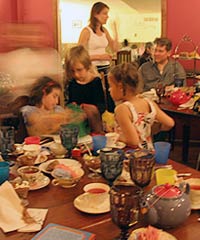
With my sister and her delightful daughter visiting us briefly, we came up with "Alice's Tea Cup" as a quick morning experience that would be rather nice for a little girl visiting Manhattan.

It was neat to see my niece (one of thirteen, and nine nephews) swing up not only a fine china teacup, but also a mug (filled with hot cocoa) nearly as big as her head. I enjoyed the scone with cream and jam, and reflected on why the pleasures Alice's Tea Cup offers are thought to be especially for women.

I like beer. I like cigars. I like single malt scotch (The Cragganmore, if you're buying...). I like watching sports, mostly live rather than on tv. But I really don't like doing any of those things when men are doing them to be self-consciously manly. It evaporates my enjoyment of those things entirely. There is even an odd Christian subculture of doing supposedly manly things like this and it comes off as posing -- what the surfers I met in La Jolla, California described derisively of those who surfed for show rather than the simple pleasure of it.

So I admire more a man I know who, in the days when Mad Men was set, went into a tough bar and ordered a glass of milk. Because he doesn't like beer, and doesn't care what the other guys at the bar thought of him.

That's manly.

Of course, this leads me to consider my own vanity. I'd rather have a suntan than not, and the adage "you can tell a lot about a man from his shoes" has probably affected my footwear choices once or twice. I do plenty of things to appear cultured, intelligent, sound (in my settings, having the right views on theology) and am not worried about appearing macho, so maybe a post about each of those is in order. But until then, I'll have a milk, please.

Thursday, January 15, 2009

Richer Wine and Marriage


A friend and former colleague used to work in London, and said that he had to convey the truth of Christianity to those whose lives, they felt, were going quite nicely. He called it a "Theology of Claret" (which means a nice red wine, a Bordeaux).

There were two parts to this, matching the aims of Gospel preaching: "to comfort the afflicted and afflict the comfortable."

The task of bringing to mind the goodness of God is one aspect, that life lived with Him is different than life without Him. It will include sorrow and persecution (that's a promise from Jesus), but it is also life that "may richer, fuller be" as the hymn goes.

The other task is to tackle what I must this weekend, which is the preaching of the Law of God such that it brings conviction of the hidden sin to those who are outwardly moral, even or especially those within the Church visible.

But as to the first, that Jesus stated his purpose was to bring life, and life to the full, I turn once again to Richard Wilbur, who gave this toast as his son's wedding:

St. John tells how, at Cana's wedding feast,
The water-pots poured wine in such amount
That by his sober count
There were a hundred gallons at the least.

It made no earthly sense, unless to show
How whatsoever love elects to bless
Brims to a sweet excess
That can without depletion overflow.

Which is to say that what love sees is true;
That this world's fullness is not made but found.
Life hungers to abound
And pour its plenty out for such as you.

Now, if your loves will lend an ear to mine,
I toast you both, good son and dear new daughter.
May you not lack for water,
And may that water smack of Cana's wine.

Do Christians seem to possess joy, or go around with faces downcast?

I think that heaven relates to both of these aspects, because it will be a great banquet, the joy of the ultimate wedding feast. It will also be the place where (as Daughter Number Two will sing lustily) "sickness, sorrow, pain and death are felt and feared no more".

Wednesday, January 14, 2009

Philosophy, Time & Poetry

Greek primordial deity Χρόνος (Chronos) strikes the hours on this pocket watch.


Time is a tricky thing to grasp. Intellectually, I mean. It seems to be easily measured in objective terms, but hard to nail down philosophically. (Do keep in mind that I am ignorant of quantum physics, which questions whether time exists at all). Because the present is, as St Augustine, described, following Greek philosophers of nearly a thousand years earlier, on the knife-edge between the past and present. He wrote "in te, anime meus, tempora metior" (in you, my mind, I measure time). He meant that the present was something that could not be grasped, and that his mind measured his impression of any moment: "I do not measure the things themselves whose passage occasioned the impression; it is the impression that I measure when I measure times. This therefore is either what times are, or I do not measure them" (as quoted in Augustine and the limits of virtue by James Wetzel, Cambridge Univ Press).

There are objective means of measuring time, of course, such as the movement of planets, or today, the movement of electrons. But this knowledge does not change that our perception affects our experience of time.

My father-in-law has written about the nature of exponential versus linear change, and uses our perception of time as an example:

Consider a very simple example – our perception of time. “A second is a second is a second”, we say. So time must be “linear”, that is, it is not accelerating. A second when we are 65 is the same as a second when we are 5. There is no acceleration there.

If that is true, then why do we feel that time is moving faster as we get older? “I can’t believe another year has gone by”, we say, as we get older. Have you ever heard a child say that? Most of us pass that off as “one of those funny things in life”.

When I am 5, one year is one year, but it is 20% of my life. When I am 50, one year is still one year, but now it is only 2% of my life. So, for me, at age 50, time has sped up. Time itself may not have sped up, but, time, for me, is accelerating.

source: http://29thday.org/book/chapter.php?chapter=1

That interests me because it accepts the objective nature of time but shows how it is inherent to our nature (as beings who live in time) to perceive the passage of time differently over the course of our lives. This shows itself in many ways, such as the clarity of my memory of certain events, or the existence of dozens of musical albums from adolesence but few since then.

What benefit is there to realizing the passage of time is "felt" differently over the course of our lives? I suppose that as we age, we get the slightest glimpse of what it is to have eternity as our experience. To have plans come to fruition over centuries rather than years, or quarters as the financial markets demand.

The Bible recognizes that God's eternal nature gives him a different view of time than his limited creatures, so Psalm 90:
For a thousand years in your sight
are but as yesterday when it is past,
or as a watch in the night.

What do you think, dear reader? How has your experience of time changed over the years? Had you in mind what your life would be in 2010? What poet captures the subjective experience of time best? Do tell.

Philosophy, Time & Poetry


Time is a tricky thing to grasp.

Intellectually, I mean. It is easily measured in objective terms, but hard to nail down philosophically. A simple example is how tricky it is to define the present, because time, as the hymn says, "like an ever rolling stream bears all its sons away". That is, it moves forward so that there is, in a sense, never any "now" that can be pinpointed.

Experientially, time is trickier still.

A philosophy professor of mine noted how time "slows down" when an athlete is in the zone. That's an experience most athletes have experienced, how the intensity of the sport (particularly competition) puts a focus on that time. I think I remember the six minutes of rowing races more than the sixty hours of practice that preceded those.

People remember their wedding day, the birth of a child, intense experiences of joy as well as grief (particularly violence) in a special way. So while we know time is linear, we don't quite experience that way. Wasn't it Poe who called sleep "little slices of death"?

Another poet, the subject of recent postings, has some great insights to offer. Again, here is Richard Wilbur, this time in the recent issue of the New Yorker magazine, a subscription of which my most excellent sister gave as a welcome to Manhattan gift:

Anterooms

by Richard Wilbur (New Yorker, January 5, 2009)

Out of the snowdrift

Which covered it, this pillared

Sundial starts to lift,


Able now at last

To let its frozen hours

Melt into the past


In bright, ticking drops.

Time so often hastens by,

Time so often stops—


Still, it strains belief

How an instant can dilate,

Or long years be brief.


Dreams, which interweave

All our times and tenses, are

What we can believe:


Dark they are, yet plain,

Coming to us now as if

Through a cobwebbed pane


Where, before our eyes,

All the living and the dead

Meet without surprise.


What has your experience been -- has an instant ever dilated for you? Or long years been brief?

Maybe we'll look again at this poem from another angle. But what he says about time has a lot of truth. On the theme of heaven and infinite time (or eternity beyond linear time), I have always been amazed to ponder the last verse of Amazing Grace: "When we've been there ten thousand years, bright shining as the sun, we've no less days to sing God's praise, then when we first begun."

Tuesday, January 6, 2009

Yesterday, Today and Forever the same...


It never ceases to amaze me how the Bible interacts with current events. That is, a long-planned out series of scripture studies seems to be just the right passage for what is happening in the news. The first rector I served under spoke of "God's Word interpreting God's world", and that's been my experience.

In the autumn, a series of discussions were planned on the Wisdom literature in the Bible, and it happened that Proverbs on the subject of wealth, identity and justice in society were lined up right with the market crash. This week, a series on the book of Judges began with troops moving into Gaza as today's news describes, too.

It proved helpful to discuss how the descriptions of Israel in the Old Testament relate today, and particularly how they do not relate in a direct manner to modern nation states (of Israel, America or (in days of Empire) Great Britain) but rather to the Church, primarily.

Turns out the book is really about the faithfulness of God to a faithless people. There's nothing new under the sun...


(In a slightly incongruous video linkage, click the title of this post to listen to Bruce Cockburn's Lord of the Starfields)

Friday, January 2, 2009

In the winter, looking to summer


The change of seasons is a marvelous thing.

I think it was CS Lewis who noted that humans inhabit time with both a linear and cyclical experience. We grow up and get old, but each year brings a rhythm of the seasons and, in my experience along with Lewis, the cycle of the church year. Now we are in Epiphany, and on Sunday I will be preaching on Matthew 2, when the magi came to Bethlehem to pay homage to the newborn king.

(Theological aside: the seasons seem to me to be part of the Creator's goodness to us, and I wonder if the new creation will have them.)

As someone resident in the Northern Hemisphere, Epiphany is also tied up with winter and snow in my mind. And that of Number One Son as well, who was answering a number of Brain Teaser questions on the car ride home from Canada on New Year's Day. He got almost all of the questions right (for the grade ahead, his proud father noted to himself), but answered the question, "what are the four seasons?" with "Spring, Summer, Fall and Snow".

He could be forgiven for mixing up snow and winter, as we were visiting our family in a remote section of Ontario, where it was minus five degrees (Fahrenheit) on our departure, with snow and ice abounding. The ice was thick on the lake, where Number One Son had skated for the first time, and where a couple of wolves were spotted the previous morning. And as we drove away, I encouraged to the children to look over the lake realizing we might next see it in the summer when the colors will be blue and green, rather than white and gray it was in its frozen state. We drove down the driveway talking about how all the colors would change, and the things we looked forward to in the summer. One of those was picking raspberries and making them into jam. I sat around too much this vacation, except when clearing some trees that were felled in a storm, and so hope for a more active visit come summer.

But staying with Richard Wilbur for awhile longer, here is a poem that was published in the New Yorker five years ago that pretty much captures the children's hopes for the summer when we return to visit grandparents. We had wild raspberry jam from last summer on toast this morning, as there was not yet any milk or eggs for breakfast, having returned late last night from the five hundred mile drive...

Blackberries for Amelia
By Richard Wilbur

Fringing the woods, the stone walls, and the lanes,
Old thickets everywhere have come alive,
Their new leaves reaching out in fans of five

From tangles overarched by this year's canes.


They have their flowers, too, it being June,
And here or there in brambled dark-and-light

Are small, five-petalled blooms of chalky white,

As random-clustered and as loosely strewn


As the far stars, of which we are now told
That ever faster do they bolt away,

And that a night may come in which, some say,

We shall have only blackness to behold.


I have no time for any change so great,
But I shall see the August weather spur

Berries to ripen where the flowers were --

Dark berries, savage-sweet and worth the wait --


And there will come the moment to be quick
And save some from the birds,and I shall need

Two pails, old clothes in which to stain and bleed,

And a grandchild to talk with while we pick.


Originally published in the New Yorker, July 7, 2003


But maybe we'll go back in the spring to make maple syrup...

Wednesday, December 24, 2008

Richard Wilbur


I have mentioned in a previous post how much I dislike the animated version of Wilbur the Pig. Here is a Wilbur I like very much, the wonderful poet Richard Wilbur. A couple of stanzas of his hymn/poem printed below will be printed on our service bulletin at Christ Church on January 4th. Wilbur does a good job, as Rembrandt does in his Adoration of the Shepherds (National Gallery, London) using with the light and the beams in the stable, showing how the shadow of the Cross is over the manger. To you is born this day in the city of David a Saviour, who is Christ the Lord!


A stable-lamp is lighted
Whose glow shall wake the sky;
The stars shall bend their voices,
And every stone shall cry.
And every stone shall cry,
And straw like gold shall shine;
A barn shall harbor heaven,
A stall become a shrine.

Yet He shall be forsaken,
And yielded up to die;
The sky shall groan and darken,
And every stone shall cry.
And every stone shall cry
For stony hearts of men:
God's blood upon the spearhead,
God's love refused again.

Richard Wilbur (1921-), A Stable-lamp Is Lighted, stanzas 1&3


Merry Christmas to all!

(click on the title of this post to hear Sufjan Stevens singing "O Come O Come Emmanuel")

Believe! And Yoda.

On Fifth Avenue this past week or two, I have seen many examples of the "Holiday" shopping bags from Macy's department store. My first reaction was that this was the typical consumerism of Christmas -- that humans just needed to believe in anything and so be better people by "having faith", no matter what the content of that faith.

But that's not what the campaign is all about, actually. It is a revival of the story of an eight year old girl named Virginia who wrote to the editor of the New York Sun asking if there was a Santa Claus (her friends said there was not). The editor's letter (available by clicking on the title link of this post) was to say that Santa does exist, along with various warmhearted statements relating to Christmas.

This reminded me of the conversation that the Authoress or I have periodically about the topic of Santa. We tell our children this: "Yes, Santa is real. He is another name for a wonderful Christian man named Nicholas who lived hundreds of years ago, and who looked after the needs of some young girls by giving them presents secretly. Today we remember him and have fun by pretending he gives us presents on Christmas." And we've found our kids register that and then get pumped up for Santa at Christmas, including the television specials...

What follows in the reaction is some form or another of condemnation, but there you have it!

Click on the title of this post to see Donald Trump and Martha Stewart, among others, reassuring us of the goodness of the season in Macy's rather admirable and touching campaign promising to raise funds for charity as long as we believe in Santa (and shop at Macy's...)

On the continuing thread of Christmas carols, I have long thought this line from Hark the Herald Angels Sing reflects Yoda's syntax. Try saying it in a Yoda voice and see if you agree....

Light and life to all He brings
Ris'n with healing in His wings.

Friday, December 19, 2008

A Circuit Breaker


I work with Aussies, and one of them used the phrase "circuit breaker" in conversation the other day. I know what that is in electricity, and in the context realised that this is roughly the same as "short circuit" in American usage. It meant to change the terms of the debate, to ask a new question. This is what the Gospel does, and on Sunday I was reminded of an example of it in history.

At the Christ Church service of Lessons & Carols, we had the children to the front of the church building to light the Advent wreath. "Silent Night" was sung as the kids went to their programs downstairs. Some friends in the church are a wonderful German family, and the dad sang "Stille Nacht" to his young son while the rest of us sang "Silent Night".

How lovely, I thought, he's singing it in the German translation. Then I caught myself. Of course, it's a German carol, not an English one! An Austrian priest wrote it around 1818 and it was translated into English about 35-40 years later. I was singing the translation, not him.

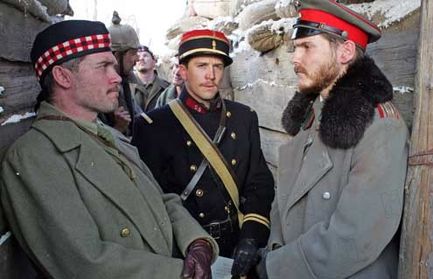
There is the wonderful account of war weary troops on Christmas Eve during World War I stopping fighting, exchanging greetings, playing football/soccer, and singing "Silent Night" together in German and English. A rather good film, "Joyeux Noel", portrays Scots, Germans and French enjoying a Christmas Eve truce.

Silent night, holy night,
All is calm, all is bright
Round yon virgin mother and Child.
Holy Infant, so tender and mild,
Sleep in heavenly peace,
Sleep in heavenly peace.

Silent night, holy night,
Shepherds quake at the sight;
Glories stream from heaven afar,
Heavenly hosts sing Alleluia!
Christ the Savior is born,
Christ the Savior is born!

Silent night, holy night,
Son of God, love’s pure light;
Radiant beams from Thy holy face
With the dawn of redeeming grace,
Jesus, Lord, at Thy birth,
Jesus, Lord, at Thy birth.

In the midst of the killing machine of the trenches, of suspicion and even in the midst of men doing their duty, it was the singing of "Stille Nacht" that provided a circuit breaker. Jesus himself often did this when conversing with those who were trying to pin him down (e.g., "Render unto Caesar what is Caesar's and unto God what is God's" or "Let he who is without sin cast the first stone").

But the very coming of Jesus is the ultimate circuit breaker in history, the dawn of redeeming grace.

So, the French film "Joyeux Noel" goes on our Netflix queue (click on title post to see an excerpt). Any carols in other languages that move you? Or any other circuit breaker moments you can relate? Do tell.


Thursday, December 18, 2008

Advent Carol


"People Get Ready", as sung by U2 in 1987. That's the link with this post. Incidentally, I saw them in concert in Philadelphia in 1987 (thanks, Greg, for scoring tickets!). It was the Joshua Tree tour, and Bono was late to the stage because he busted his arm somehow. He thrilled some guy in the audience by having him come on stage to play People Get Ready. I think Bruce Springsteen came out the next night to play that song. I love the sound of both Bono and the Boss, but together it's like two of my favourite things that just don't mix -- like egg salad and peanut butter.

Anyway, the point is that "People Get Ready", probably best sung by Curtis Mayfield with a close second by Rod Stewart and Jeff Beck, is congruent with Advent. And the best Christmas carols also flag up the theme of Advent -- Christ came (humbly, as a baby) and Christ coming again (in glory).

"O Come, O Come, Emmanuel" expresses this hope:

O come, Thou Key of David, come
And open wide our heavenly home
Make safe the way that leads on high
And close the path to misery

Rejoice! Rejoice! Emmanuel Shall come to thee O Israel


There are such wonderful allusions to the whole of scripture in that carol -- do you have a favourite verse? Or another Advent themed carol you enjoy? Or a Rod Stewart song that you love?

Wednesday, December 17, 2008

I Used to Row


I started rowing when I was sixteen, and in earnest in college, then quietly for about five years, then in earnest again in graduate school, then not much in the subsequent years.

For many years, I could describe myself as a rower because I had recently been doing just that.

No longer!

Moving to NYC has been wonderful, but rowing is not really possible here, even when surrounded by rivers on the island of Manhattan. A "road not taken" in life has been boarding school or college chaplaincy, probably in the UK, which likely would have involved quite a bit of time in boats.

Frank Sinatra did it his way; in terms of regrets, he had a few. In England, I often heard people say, "I have no regrets". I hear it in North America, too, but less. I regret not having been able (or found a way) to row for more years than I have. Maybe the opportunity will come again.

I first was intrigued by rowing as a boy when, sitting on the dock of my grandfather's house on Squam Lake in New Hampshire for the sunrise, saw a single sculler (in a fine polished wooden shell and wooden sculls, no less) slowly moving by. The effect of the sun dancing off of the water dripping from the blades as the perfectly balanced sculler moved through the water was magical. In reality, competitive rowing involves a huge amount of absolute agony as speed is generated. That has its own excitement, but it was the beauty of the sport that first grabbed me. And not only the sight of it, but also the sound of it - the swoosh and pop of the oar moving through the water to the release.


So in this little series on Christmas carols, how does rowing relate? For a short time, I had a bit of glory from success in rowing. Now my kids drink milk from old trophy mugs and a portrait of my Cambridge boat props up something in the hallway. Most other photos, shirts and such are in a box somewhere. And if I was in a boat, I would go as fast as the Tellytubby in the photo! But for a time, there was the glory of victory. And I lay it aside through circumstance and, if my self-description is any measure, grudgingly. Not so for the second person of the Trinity, who laid aside his glory mildly:


Mild he lays his glory by,
Born that man no more may die:
Born to raise the sons of earth,
Born to give them second birth.
Hark! the herald angels sing,
"Glory to the newborn King!


After having viewed the video linked to the title of this post, I'm thinking maybe I'll get on the water again...

Tuesday, December 16, 2008

Cosmic and Personal


Joy to the world, the Lord is come!
Let earth receive her King;
Let every heart prepare Him room,
And Heaven and nature sing,
And Heaven, and Heaven, and nature sing.

Joy to the earth, the Savior reigns!
Let men their songs employ;
While fields and floods, rocks, hills and plains
Repeat the sounding joy,
Repeat, repeat, the sounding joy.

No more let sins and sorrows grow,
Nor thorns infest the ground;
He comes to make His blessings flow
Far as the curse is found,
Far as, far as, the curse is found.

He rules the world with truth and grace,
And makes the nations prove
The glories of His righteousness,
And wonders of His love,
And wonders, wonders, of His love.


At Christ Church on Sunday, we celebrated Lessons & Carols, and this was our final carol to conclude the service. It was noted how the carol describes the cosmic, universal significance of Jesus: that the King is worshipped by all Creation, even rocks, hills and plains; that He has dealt with the sin of the world (far as the curse is found) and that He is the Word made flesh who dwelt among us ('grace and truth' -- have a look at John 1.14, or listen for it at your Christmas Eve service). The extent of His reign is total, over all nations, indeed over all Creation, and thus all heaven and nature sings for joy at His coming.

And yet.

And yet the world is comprised of individual people. As Margaret Thatcher said to the dismay of many in Britain in 1987: "There is no such thing as society. There are individual men and women, and there are families." Joy to the World encourages the whole world to receive Jesus as King, and then makes it quite personal: Let every heart prepare Him room.

Which line do you find most striking?


Monday, December 15, 2008

Christmas Menace

Have you ever noticed that carolers threaten those they visit in this one?


We wish you a Merry Christmas and a Happy New Year.

Good tidings we bring to you and your kin;

Good tidings for Christmas and a Happy New Year.

Oh, bring us a figgy pudding;

Oh, bring us a figgy pudding;

Oh, bring us a figgy pudding and a cup of good cheer: Refrain

We won't go until we get some;

We won't go until we get some;

We won't go until we get some, so bring some out here

Once in Royal David's City


Christmas Carols are a wonder to me. They are such a great example of truth and beauty gathered together in worship of God, while giving joy to people.

The beauty and joy of singing these in worship comes together in this season, particularly in the Service of Nine Lessons & Carols started at King's College, Cambridge a century ago, and celebrated at Christ Church yesterday. The good theology of carols is somewhat overlooked, and so for the next few days, I hope to post on a number of Christmas carols that have special meaning for me, and convey wonderful truth.

Sometimes I am asked, "when did you decide you wanted to be ordained?". That question can be asked with curiosity, hostility or admiration, depending on a person's response to the Gospel, to me, or to clergy or a church in their own past. But my answer is this: As a child, I wasn't really sure exactly what I wanted to be when I grew up. But ordained ministry was not a negative idea for me as it is for many people, because I had such good models in the ministers at my home church. Particularly the men like Dan Sullivan and Laurie Thompson, and even Joe Hess who was a bit cranky but all of them were both gentle and strong Christian men and clergymen in my earliest years.

So there wasn't as much to "get over" in terms of thinking about being an Anglican clergyman for me as others experience. Neither did I have a sentimental view that all I ever wanted to do was full-time ministry. But in the end, sentiment played a big part in how God grabbed my attention. I was ushering at Trinity College's Lessons & Carols my senior year, and had a profound sense that I should be in leadership in the Church. The singing of Once in Royal David's City (click on title post to listen) stood out to me. The last verse captured what I thought (and still think) about ministry -- introducing Jesus Christ to people so that they may long to spend eternity with Him:

Not in that poor lowly stable
with the oxen standing by
we shall see him, but in heaven,
set at God's right hand on high:
there his children gather round
bright like stars, with glory crowned.


Friday, December 12, 2008

Burgermeister Meisterburger


It's time for the Christmas specials!

"Santa Claus is Comin' to Town" was on the other night, and has some surprisingly warm allusions Jesus being born on Christmas rather than just the gift for children stuff. I forgot that the central story is a worn out and rather evil old wizard who, on meeting Kris Kringle, is changed to a good man. He's the one who gives Kris the flying reindeer and all the trimmings of the job. For some reason, Kris has a pet penguin as his accomplice in his early days. These were spent defying the law of the Burgermeister Meisterburger, who leads a paramilitary police force (and the only one sporting a German accent) to snuff out toys.

What is striking is that the goodness of Kris Kringle's motivations is accompanied by a massive behavioural modification programme -- the naughty and nice list, to see who gets toys. I grew up with this in the background, but it's pretty hard hitting in the show -- be good or you won't get loved by Santa! I've heard that in Austria, children really are at risk of getting coal in their stockings if they've misbehaved, while their brother or sister might get gifts. Can anyone confirm?

In any case, the Christmas specials are a blast. These puppet ones are the best, with such characters as Yukon Cornelius ("Bumbles Bounce!"), Herbie the Elf ("I want to be a dentist"), the SnowMiser and HeatMiser ("Whatever I touch, turns to snow in my clutch, I'm too much") and many more.

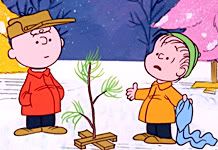
I like the animated ones too. Charlie Brown is tops. Frosty I could do without. I always wanted him to melt, just like I rather wanted Wilbur the Pig to be made into bacon after a few minutes of his whingeing on "Charlotte's Web". When Linus reads Luke 2 in the Charlie Brown Christmas special, it's a great moment.

What about you? What are your favourite Christmas specials?

Tuesday, December 9, 2008

Gold


I left a post on the site of a thoughtful guy I met at church recently, on the topic of value we assign to objects. The topic of his post was how much is paid for art, and what the inherent value of art might be. I wrote this:

Do material things (besides people) have inherent value? I think so. A thing of beauty should be valued in the sense of being esteemed, and a useful thing should be valued in the sense of not wasting it (such as food). But I am not sure about the use of the word "value" as an absolute category when describing the means to purchase something. Currency is something of a phantom, a little unreal.

A member of my extended family is ready for a total collapse of the economy, having a fair amount tucked away in specie (precious metal coins). In fact, I think he might actually long for a complete economic meltdown so that he can tender these coins!

Earnest Shackleton, whose ship was trapped in ice and led his men over land in their South Pole expedition, commanded the men to leave aside anything that wouldn't keep them alive. He added to the great heap of things to be left the gold sovereigns in his possession. But he picked up a volume of Browning, saying 'I throw away trash [gold sovereigns] and am rewarded with golden inspirations'.

Makes you want to read Browning, doesn't it?

Monday, December 8, 2008

I am the Greatest!


I've been praying for a friend whose son is terribly ill, though recovering, and thinking about times when my children have suffered. While what my kids have endured has not approached his experience, and the emergencies were of shorter duration, the fact is that the suffering of a child is of a different quality than other human suffering.

God the Father is not immune to the suffering of a child, of course, and in the strangest solution to the suffering and sorrow in the world, sent His Son to be born as a baby who would, in due time, suffer death, even death on a cross (cf Philippians 2). So while Muhammad Ali was probably the greatest boxer, the image on Esquire magazine in the third photo shows him in weakness (in the pose of St. Sebastian, who died for his faith in Christ). Then he is more like the Greatest than he is picking the round he will knock out his opponent. But the greatest in the eyes of the Creator is the second photo, of a little child.


Matthew 18.1-6
At that time the disciples came to Jesus, saying, “Who is the greatest in the kingdom of heaven?” And calling to him a child, he put him in the midst of them and said, “Truly, I say to you, unless you turn and become like children, you will never enter the kingdom of heaven. Whoever humbles himself like this child is the greatest in the kingdom of heaven."

“Whoever receives one such child in my name receives me, but whoever causes one of these little ones who believe in me to sin, it would be better for him to have a great millstone fastened around his neck and to be drowned in the depth of the sea."

I am not going through what my friend is going through. I do trust that God is neither immune from the sorrow of this situation, nor absent from this family in this trial which He has brought to them. The purpose for that is as yet unknown.

Does suffering perplex you? It does me, and yet it doesn't, knowing God is in charge. Sometimes makes me angry, or confused, certainly. What about you?

On a much lighter note, click the title of this post to see a cartoon of Muhammad Ali as an astronaut cartoon hero.

Friday, December 5, 2008

Denny Crane...Denny Crane...Hi, Denny Crane


Braggadocious, misogynistic, outrageous and generally over the top. That's Denny Crane on Boston Legal. A man who walks in a room and simply repeats his name, "Denny Crane", as if that's all that needs to be said. Continuing the tv theme, Boston Legal is a show that I like, though the lewdness of it distracts from the greatness and interest of the show, which is William Shatner's character --- a successful man dealing with his diminished capacities as age catches him. Alongside this is a wonderful friendship between two men, Denny Crane and Alan Shore (Shatner and Spader). Returning to the theme of eternal hope, Denny Crane asks about what our bodies will be like in heaven. I was grateful that another blog posted the conversation:

Denny Crane, asks, “Do you think in heaven I’ll have Mad Cow?”

(Mad Cow is his code word for his Alzheimer’s).

Spader pauses to take a drink, then says, “Denny, I think in heaven you will be as you were in the prime of your life.”

Denny Crane nods in contemplation. “Then I’ll be just as I am now,” he says and raises his drink to Spader.

That bravado of Denny's is a very transparent papering over of his insecurity. Yet it is so grotesquely transparent that it becomes endearing. The truth is Denny longs for his youth, when he had full command of his faculties, and when he was respected and feared rather than something of a buffoon. But his ego will not allow him to admit anything but that he is greater with each passing year.

The comforting truth, if a bit sobering, is that while age is a mark of honour and should be respected, our capacities do diminish. Fifty is the new forty, forty is the new thirty, etc. tell us that we aren't getting older. But we are. Age isn't just in your mind. We really get old. And creaky. And this makes me long for the resurrection, so that I won't be just as I am now.

How about you? Are you with Denny Crane on this one?


Meat and Bones


I saw an episode of the television series Mad Men. The plot seemed thin, the driving theme appeared to be a rejoicing in the time when women's liberation had not yet taken hold, but when sexual mores had begun to loosen. The beatnik rather than the hippie era. I don't have all the backstories, but a number of the characters drew my interest, while others were fairly shallow and unappealing. Many of my friends love it.

What I did like was how people looked! The Authoress (n.b.: my wife) and I were in a diner the other day, before our appointed hour to visit some lovely friends from our church who were recently blessed with a baby. The diner had a 1940's/50's theme to it, and showed a picture of Miss America contestants from about 1953. The Authoress mentioned how the idea of beauty changes with each generation, and how those women would all be considered overweight today.

Too bad.

This is bad for women who starve themselves to look tiny. It's bad for men who seem to want women to look like girls, perhaps thereby recalling their own youth? It's bad for men, too, who need to be too slender as well -- what if I really do need to live for awhile without sufficient food -- I'll be glad for the extra I'm carrying around then!

So I was delighted to see people a bit soft around the edges. Normal, to my eyes. Maybe the plague of obesity our culture has today is a reaction to the ideal of beauty being so far from what is possible for most to obtain.

The woman who reviews television shows at the New York Sun has this to say:

Meat is important, too on them. The "Mad Men" women have some meat on their bones, an extra 10 pounds they'd be working like crazy to get rid of today. A little roundness made their skin look young and their legs look nice. In the show, at least, everyone also always seems to be eating meat steaks sizzling with fat or home-cooked roast beef, and no one is talking about cholesterol. Not even the doctors. Of course, they're weren't talking about the rampant alcoholism, either. But still. It would be nice to eat more steak.

But I digress. I guess I've lost the point, too. Certainly the Bible hails inner beauty, but does not reject the idea of men or women having physical beauty. It rejoices in beauty. I'm guessing if the resurrection does mean our bodies are transformed but recognizably us, the result will be closer to Mad Men type of bodies than those we idealise today.

Your view? In this stretch between Thanksgiving and Christmas, are we better off with a few more pounds? In the photos, do Don & Betty have more wisdom about bodies than the folks of today?

Thursday, December 4, 2008

BBC America


 To get any channels at all where we live, cable television is required, the first time I've ever had it.  And along with cable comes BBC America.  

Joy inexpressible.

Mainly I enjoy older comedy troupes and duos, period dramas... British science fiction even seems more thoughtful.  But along with these genre is the auto show called Top Gear.  Essentially, the show involves three men driving super cars and saying how wonderful they are, and then also thinking of crazy things to do with regular cars.  It's fantastic stuff.  Click on the link to see their football/soccer match.

A truly marvelous episode is the race between the presenters to the North Pole, one by dog sled, one by pickup truck.  

Are you a fan?


Wednesday, December 3, 2008

The god of Fifth Avenue


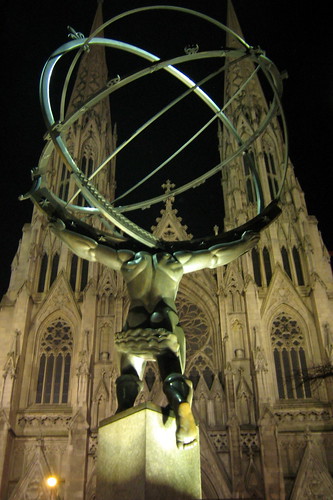
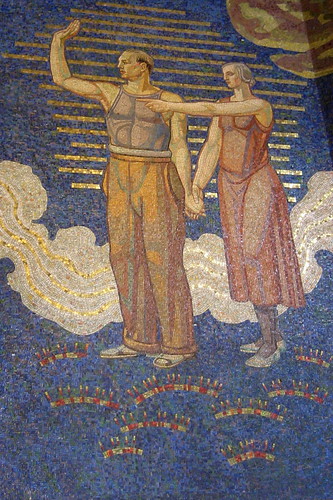
Walking down Fifth Avenue, at 50th Street one is struck by the face-off of St Patrick's Cathedral and the statue of Atlas at Rockefeller Center. While the statue is based on the Greek mythology of Atlas holding the sky/the world upon his shoulders, in the context of the architecture of Rockefeller Center, it really celebrates modernism and the power of Man. This is shown by the central place of Prometheus (who stole fire from the gods for humanity) as well as the many mosaics and reliefs celebrating the human spirit and things like "commerce", "industry", "transport" and so on.

Many have noted before that there is something of a squaring off of divine versus human. But in December, Consumption is king. It is impossible to move around at the intersection of Fifth & 50th because of holiday shoppers. And on the day after Thanksgiving, retail sales were up this year, in the midst of the most severe economic downturn for decades. I am not going to my regular office nearby there today, because of the lighting of the Christmas tree at Rockefeller Center making for hoardes of crowds. This is no bah humbug -- I love Christmas and love it in NYC. This is merely to point out that the old battle between cathedrals to God or cathedrals to Man have been bypassed, at least for the month of December at Fifth & 50th. The new god is StuffToBuyOnCredit and instead of cathedrals, he has many small churches (Tiffany's, Saks', Macy's, etc.) where his worshippers flock in droves.

On a lighter note, the video link is John Denver singing Silver Bells.

Tuesday, December 2, 2008

Really Important People


A friend and fellow minister and I were discussing the tendency in New York (as anywhere, but especially here) to try to get to the right places to see the right people. Not much remarkable about that, except that it occurs in Christian settings -- there are actually "the right places to go to meet the right people" within the social milieu of Christian activities in Manhattan.

Ugh.

My dislike of such "networking" is a measure of self righteousness, I'm sure, but also mere self preservation -- on two counts. First, I forget that all the folks who attend such events actually need whatever is being provided to them, and don't need a minister of the Gospel trying to tell them about another new venture they can support. To be in that setting dampens the spark in one's spirit very quickly indeed. Second, when I have gone to hear an interesting speaker in such settings, I inevitably only meet people who serve in Christian ministries talking about people in influential positions in such a way that a person has ceased to be considered a person.

Further, there is a prevalent notion that a Christian minister should tell people to follow Jesus the teacher rather than proclaim the Gospel of Jesus Christ as Lord. This is especially strange approaching Christmas, when the infant King of Kings was worshipped and hallowed before he could even say "goo goo, gaa gaa" let alone "do unto others as you would have them do unto you." But that's a topic for another day. I leave the event with a handful of business cards and a diminished sense of the priority of seeking out those who are, to put it simply, spiritually lost.

A friend in college had a lovely habit of slamming his palm on the table when anyone dropped a name in conversation. It was even more effective when he would do it while standing up, drink in hand, slamming the imaginary table in front of him. Click on the title post for a lovely "Two Ronnies" sketch on name dropping.

Come to think of it, I think I name dropped the other night. Pray for me.

Monday, December 1, 2008

A Faith that Scares


In the midst of the thrill of Christmas decorations which dominate Manhattan, this church season is primarily one of preparation for the end of things and the new creation.

Matthew 24 includes this obviously good news:

14 And this gospel of the kingdom will be proclaimed throughout the whole world as a testimony to all nations, and then the end will come.


The less obviously good news from that same chapter:

21 For then there will be great distress, such as has not been from the beginning of the world until now, no, and never will be. 22 And if those days had not been cut short, no human being would be saved. But for the sake of the elect those days will be cut short.

and

28 Wherever the corpse is, there the vultures will gather.

Vultures! Put that next to the description by commentator Tucker Carlson, on his usual Sunday church experience:

"You'll never meet nicer people. If you needed someone to hold your wallet, or if you were lost in an unfamiliar neighborhood and had to duck into a stranger's house to use the bathroom, you could do a whole lot worse...No one has better manners. And that may be the problem. There's a notable lack of urgency...Jesus may have promised he'd come back someday, but in [my church] you don't get the feeling he really meant it. Nor do you hear a lot about sin. Lust, hatred, gluttony, pride, envy -- those are dramatic emotions. ...

The typical sermon leaves the impression that all would be well in this world if only people could manage to be reasonable with each other. Gentlemanly. Thoughtful.

There's nothing necessarily bad about any of this. (I remain [a member], with no plans to change.) But every once in a while, as I shift in my pew listening to one of our unusually well-educated preachers expand on the Aramaic understanding of discipleship, I do wish Jesus would come back, preferably in a massive ball of fire through the ceiling of the church. Spiritually, I'm nowhere near ready to face something like that. But it'd be worth it for the shock value....Dead religions don't give people the creeps...But Christianity still does. What a relief. It's nice to see that our faith still scares people."

(source: www.msnbc.com, Dec 7th, 2005 “The Situation” television show w/T Carlson)

It's possible on the one hand to look at whacky predictions of the parousia (fancy term for the Second Coming) involving Soviet tanks a generation ago, or whatever today's equivalent might be. Or on the other hand to seek to distill the essence of all religions in the form of timeless moral teaching. But Christianity as found in the Bible speaks of Jesus entering history. As a baby. To live the perfect life, and to seek and save the lost, giving his life as a ransom for many. And then to return again in glory, as judge. That touches our lives, because we live in history. It is a faith that scares because everything will be wrapped up by him. You and I aren't in charge. Scary or reassuring? What do you think?

(video link -- click on post title: I thought it was neat when the Terminator show used a Johnny Cash song)


Friday, November 28, 2008

"Clarence, where's Mary?"


Between Thanksgiving and Christmas, the moon will go through a full phase, the earth will rotate on its axis a couple of dozen times, Helium will remain the second element on the Periodic Table, and I will watch "It's a Wonderful Life", the Frank Capra film starring Jimmy Stewart and Donna Reed.

I love this film, even though I know it is a fanciful portrayal of both America and family life, not to mention an angel named Clarence who teaches George Bailey to "Remember no man is a failure who has friends." The notion of examining what the world would be like without me in it is even appealing.

But what also strikes me in the film is one small feature that is at least ambivalent in terms of Christian teaching, and possibly opposed to it.

The question is: does the portrayal of Mary Bailey as "an old maid" who works in the library show that the film really has not just a wonderful view of family life (happiness in spite of the father not reaching the level of financial success in life he desires, and at some level being constantly frustrated with his situation)...does it also stray into an idolatry of the family? I'm not sure. Here are the possibilities, and you may think of others:

1. George's horror at Mary being unmarried is a reflection that because he never lived, her life has somehow been wasted because she never married. This would deny the goodness of single life, as Jesus and Paul both taught, as a state to be held up alongside or even in higher regard than marriage and family life.

2. George's horror at Mary being unmarried is more personal, in that it means the happiness the two of them shared never happened. And that their children do not exist in the world where George Bailey never lived.

It's possible that both are true in the film, i.e., that Clarence's description of Mary as an "old maid" reveals this to be a terrible blow, while George reacts at a much more personal level. Certainly not everyone in Bedford Falls or Pottersville is shown to be married and with kids to be happy, though Ma Bailey and her bitterness would indicate that growing old without children made her angry enough at life.

What are your thoughts on this idea in "It's a Wonderful Life", or just your favourite scene from the film? Or even your favourite element on the periodic table (mine is Krypton, 36, with hopes that one day Kryptonite can be made from that gas...)

Wednesday, November 26, 2008

Luca Brasi sleeps with the fishes

Number One Son proved the accuracy of a commercial I remember from some years' back.  Or perhaps it was a print advertisement.  It showed the parents of a young child fighting or using rather blue language in any case, and had a tag line "sensitive recording devices" to describe how children pick up things adults say.  This was certainly true in our household recently...

I asked the Authoress to pass me something while I was holding The Baby.  To be clear about it, I said something along the lines of "pass me the blanket, leave the pacifier".  The reply was "that sounded like The Godfather, 'Leave the gun, take the canoli'".  Smiling, I say, "It was meant to."  Number One Son was playing nearby.

At dinner that evening, Number One Son hears one of us say at the table, "would you please take this to the kitchen?".  And he blurts out, "Leave the gun, take the canoli".  We thought it was rather amusing, but it does rather make the point about kids taking in everything that is said in their presence.

"Train up a child in the way he should go:  and when he is old, he will not depart from it."  Proverbs 22.6.  I want my kids to know all the great movie lines, but when is the right time to teach them these?

On a separate note, guys seem to know this line while many women don't.  This morning, some women in a Bible study were ignorant of it, but did know line:  "Go to the mattresses", not from The Godfather itself, but from the romantic comedy You've Got Mail.


Tuesday, November 25, 2008

It's all happening in Manhattan...


Gosspi Girl was filming in the sweets shop my son looks forward to for a weekly selection of five pieces of loose candy. And down on Wall Street today for a weekly meeting, I saw beyond the immense Christmas tree put up by the Stock Exchange, men in period British army uniforms were playing band tunes on the steps of the Federal Hall where Washington's inauguration took place. This reminds me of a retort my English expatriate friend Simon Barnes would make when Americans would make joking remarks on the Fourth of July: "Of course, in England, we call that 'Thanksgiving Day'". Very droll, indeed. What if things had turned out differently in history, and the American Revolution had been a rebellion successfully put down? The sight of Redcoats on the steps of Federal Hall would be normal, not unusual... (click on the title to see an imaginary version of WW2 being lost by the Allies).

Jesus said in Matthew 24 (which I am preaching this coming first Sunday of Advent) that impressive buildings would be cast down and various strange events would signal the end times. I take today's events as an encouragement to be found ready! What do you think, dear reader?

Monday, November 24, 2008

Artistic Immortality?


Preaching Revelation 21 this weekend, I was struck by the scene of the Holy City receiving a delivery from the kings and peoples of the earth. John Stott remarks on these verses:

At this point we need to consider Revelation 21:24,26: "The kings of the earth will bring their splendor into it" and "the glory and honor of the nations will be brought into it." We should not hesitate to affirm that the cultural treasures of the world will enrich the new Jerusalem. Nature is what God gives us; culture is what human beings make of it. Since human beings are ambiguous, so is their culture. Some of it is evil and even demonic, but some of it is also beautiful, good, and true. It is this which will adorn the Holy City."

It occurs to me that many artists seek to achieve immortality through their art outlasting their own life. So the Sistine Chapel is Michelangelo's legacy, and such pieces as the Wind Serenade No. 10 for Mozart are thought to have achieved immortality (click on post title to listen). But only as long as the chapel stands or people still play/listen to this music. There is every indication from those verses in Rev 21, however, that the beauty of our fallen world will, in some way, give glory to God in the renewed creation.

I don't think that Velvet Elvis paintings will make the cut, however...